
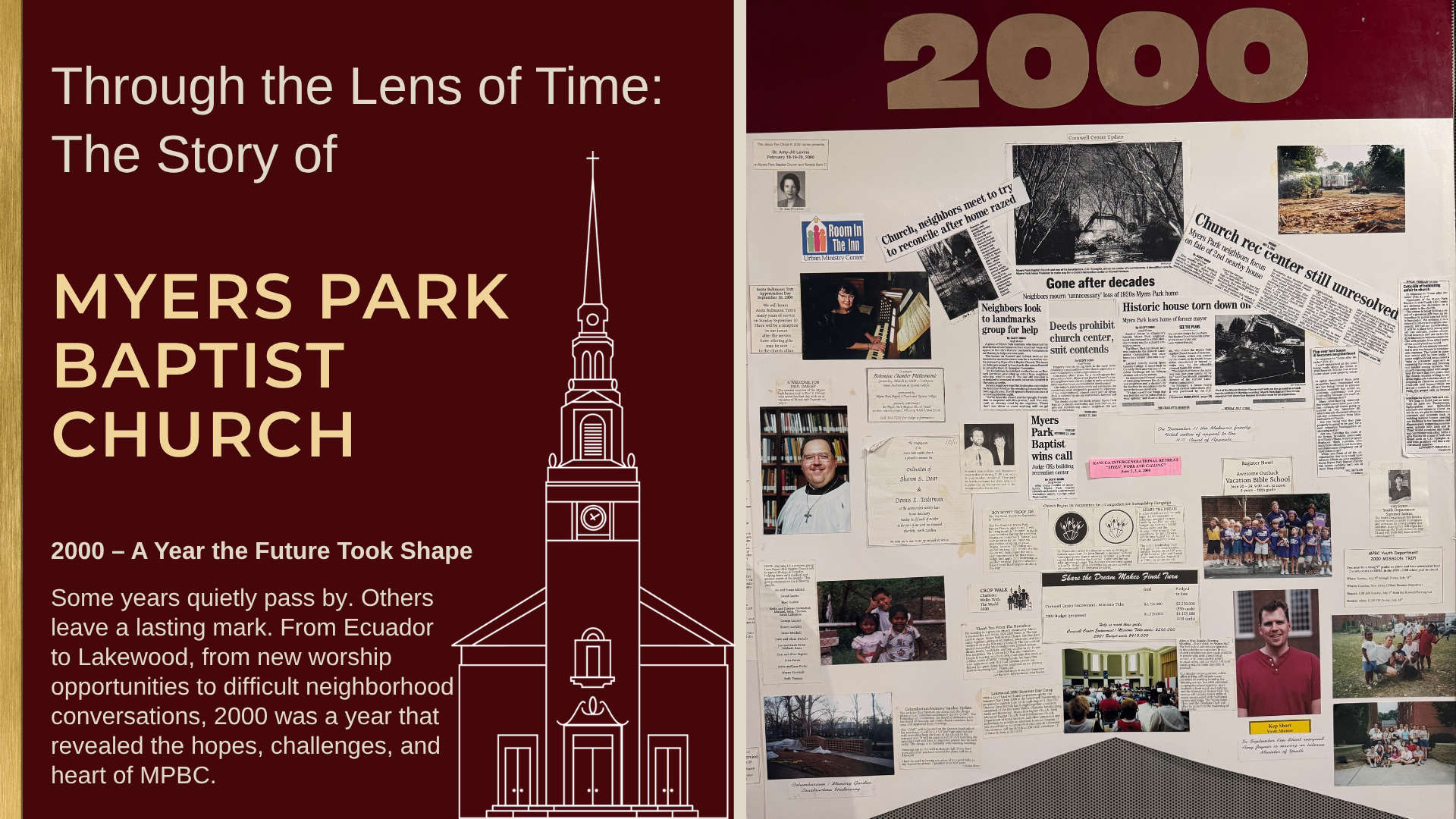
2000 - A Year the Future Took Shape
The year 2000 brought both energy and uncertainty to Myers Park Baptist Church. New ministries emerged, mission efforts expanded, and plans for the church's future gained momentum. At the same time, conversations about growth, stewardship, and the changing landscape of the Myers Park neighborhood challenged the congregation to consider what faithful ministry would look like in a new century. Looking back, the year's story is one of vision, service, celebration, and the sometimes-difficult work of balancing tradition with change.
Building for Remembrance and the Future
In 2000, church leaders continued planning for a project that would honor both the past and future generations of Myers Park Baptist. The architect completed the design phase for the proposed Columbarium and Memory Garden, and the plans received approval from the Columbarium Committee, Board of Administration, Board of Deacons, and many members of the congregation.
Located on the Queens Road side of the sanctuary, the memorial space was designed as a four-and-a-half-foot semi-circular brick wall extending from the front of the church to the transept area. Each niche would feature an engraved granite face, and the overall design was carefully crafted to complement the sanctuary and surrounding church buildings. As members viewed the drawings displayed in Heaton Hall, the project represented more than a construction effort. It reflected a growing desire to provide a sacred place where memories could be preserved within the life of the church.
At the same time, leaders were looking toward other ambitious plans for the church campus. As preparations continued for the proposed Cornwell Center, the congregation voted to engage stewardship consultant Dr. John Hewett, a former Baptist minister and professional fundraiser, to assist with the capital campaign and the 2001 operating budget. The unanimous support of the deacons underscored the church's commitment to thoughtful planning as it prepared for a new era of ministry.
Serving Charlotte's Neighbors
The year demonstrated Myers Park Baptist's deepening commitment to community ministry.
One of the most visible examples was the Lakewood 2000 Summer Day Camp, a collaborative effort led by Community Development Center Director Dave Nichols. The program brought together the McCrorey YMCA, Charlotte-Mecklenburg Parks and Recreation, Faith Memorial Baptist Church, First Presbyterian Church, the Department of Social Services, and numerous volunteers. Through this partnership, children in the Lakewood community were provided opportunities for learning, recreation, and support throughout the summer months.
The church also continued its longstanding involvement with Room In The Inn, providing hospitality and assistance to Charlotte's unhoused neighbors. As the 1999-2000 season concluded, church members reflected on another successful year of ministry. Congregants provided more than 210 bed spaces, evening meals, breakfasts, and bag lunches through their collective efforts.
The impact of that ministry could be measured not only in numbers but in lives transformed. During the year, one homeless couple moved into an apartment of their own, a milestone made possible through the support and encouragement they received from volunteers. Leaders Lea Harrison, Bill Prestwood, and John Reeves expressed gratitude for the generosity that made the ministry possible and for the ways it helped members grow in compassion and understanding.
A Church on Mission
While serving neighbors close to home, Myers Park Baptist also extended its ministry far beyond Charlotte.
A mission team traveled to Ecuador for ten days of service, providing medical assistance and responding to practical needs in local communities. Participants included Joe and Susan Aldrich, David Gaskin, Reed Gaskin, Keith and Darlene Korenchuk (with Michael, John, Thomas, and Sarah Catherine), George Linney, Sidney Lockaby, Grace Mitchell, Dave and Chini Nichols, Joe and Sarah Parisi (with Michael and Anna), Curt and Alice Pegram, Erica Prater, Steve and Jane Prater, Wayne Stirewalt, and Ruth Thomas.
The church's youth also embraced hands-on mission work. During the summer, students traveled to Camden, New Jersey, where they served with Urban Promise Ministries. The experience challenged participants to live out their faith through service, leadership, and relationship-building while offering a glimpse of the church's growing emphasis on experiential mission opportunities for young people.
Honoring Leaders and Welcoming New Voices
The year brought several significant moments of celebration and transition.
On October 15, 2000, the congregation gathered to celebrate the ordination of Sharon S. Doar and Dennis E. Testerman, affirming their call to ministry and recognizing their gifts for service and leadership.
The church also welcomed Paul E. Oakley, who began his work as Minister of Music and Organist on July 2. His arrival marked a new chapter in the church's music ministry and worship leadership.
Investment in younger generations remained a priority as well. The Youth Department welcomed Amy Joyner as its summer intern, assisting with programs and activities designed to nurture the faith and development of young people.
Another notable occasion occurred on September 10, when the congregation honored Anita Bultmann Tritt for her many years of faithful service. A special reception celebrated her contributions and the lasting influence she had on the life of the church.
Worshiping in New Ways
While Myers Park Baptist remained deeply rooted in its traditions, the year also brought new approaches to worship.
The church launched Alive at Five, a Sunday evening service held in Heaton Hall. Designed to complement the church's traditional morning worship, the service offered a more intimate setting and incorporated a blend of contemporary music, traditional hymns, and expanded congregational participation.
Youth and children played significant leadership roles, while the Young Spirit Choir and Cambiata Choir frequently helped lead worship. For many members, Alive at Five provided a new way to engage in worship while remaining grounded in the church's commitment to thoughtful preaching and meaningful biblical reflection.
Growth, Preservation, and Difficult Conversations
Not every story of 2000 was celebratory.
As plans advanced for the proposed family life and recreation center, the church became the subject of growing public discussion within the Myers Park neighborhood. The project, supported by a major pledge from the C.D. Spangler Foundation, required the removal or relocation of several nearby houses.
Neighborhood residents voiced concerns about preserving the historic character of Myers Park, one of Charlotte's oldest residential communities. Preservation advocates appealed to the Historic Landmarks Commission to evaluate several homes slated for removal, while attorneys debated the implications of longstanding deed restrictions intended to protect residential development within the neighborhood.
One of the most emotional moments came with the demolition of the Bland-McAden House, a historic home dating to the early 1920s and associated with a former Charlotte mayor. The loss became a focal point for community frustration and sparked ongoing dialogue about balancing preservation with progress.
Church leaders sought to address concerns and work toward compromise. Under the leadership of Building Committee Chair Skip Gribble, revised plans included a reduced roofline and design modifications intended to lessen the impact on surrounding properties. Even so, conversations continued throughout the year as church leaders and neighbors searched for common ground.
Looking back, these debates reveal a congregation grappling with complicated questions that many growing churches eventually face: How can a church expand its ministry while remaining a good neighbor? How should the needs of the future be balanced with the preservation of the past?
Looking Ahead
Looking back through the lens of time, 2000 reveals a congregation actively discerning its future. Myers Park Baptist expanded its ministry through missions, community partnerships, and new opportunities for worship while also wrestling with questions about growth, neighborhood identity, and the preservation of history. The year offered few easy answers, yet it demonstrated a willingness to engage both opportunity and challenge with faith and purpose. As the new century began, the church continued its journey much as it always had, seeking to honor its past while trusting God to guide the path ahead.