
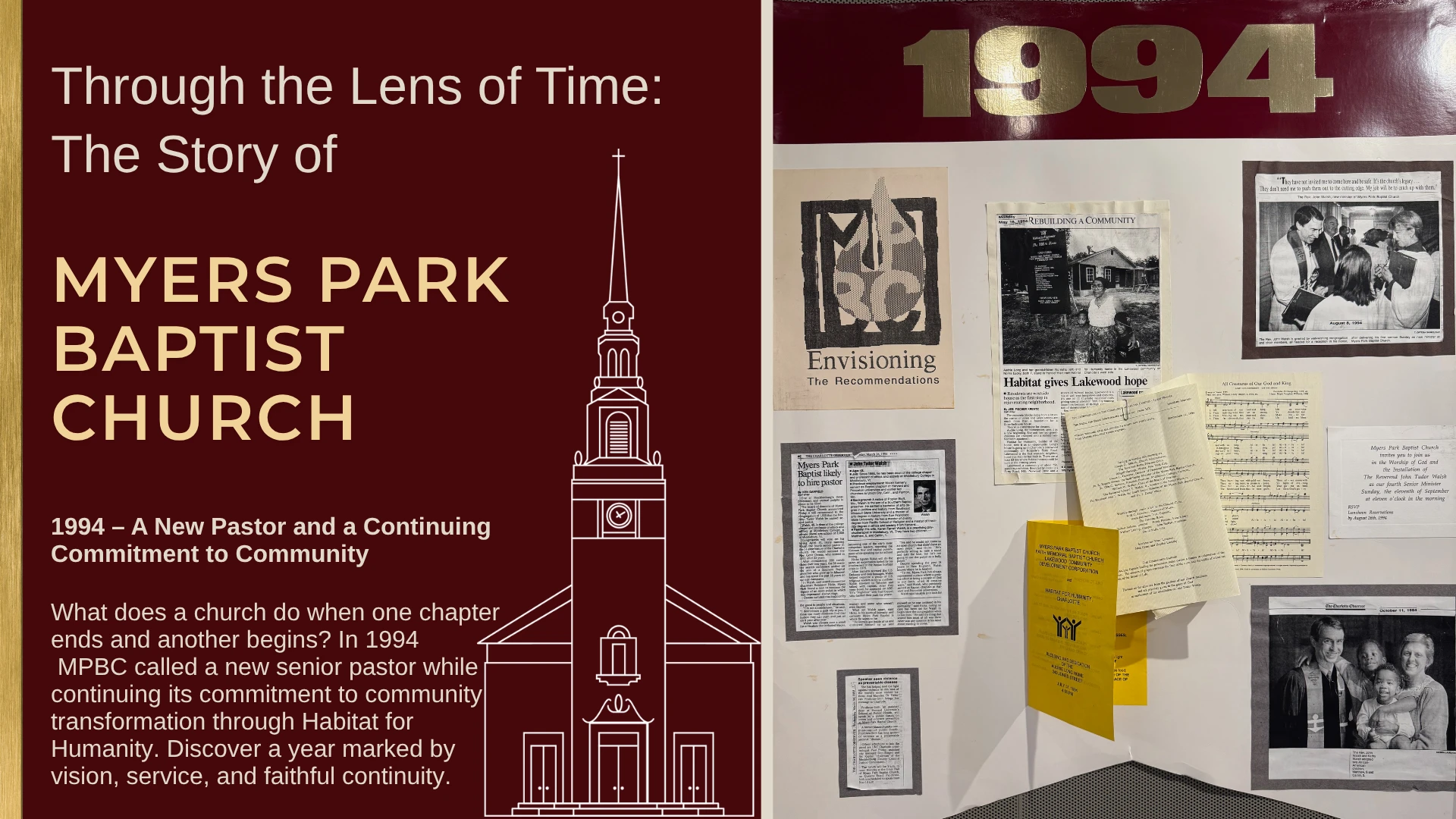
1994 - A New Pastor and a Continuing Commitment to Community
The year 1994 marked a significant turning point in the life of Myers Park Baptist Church. Standing at the intersection of past and future, the congregation welcomed new pastoral leadership while remaining firmly rooted in the convictions that had shaped its identity for generations. As members discerned who would guide the church into its next chapter, they also continued the work of living out their faith beyond the sanctuary walls. From the calling of a pastor who embraced thoughtful engagement with the world to partnerships that helped strengthen Charlotte neighborhoods, 1994 was a year that revealed how Myers Park Baptist balanced change with continuity, vision with action, and faith with service.
John Tudor Walsh Called to Myers Park Baptist Church
In 1994, Myers Park Baptist Church entered a new chapter in its history with the calling of the Rev. John Tudor Walsh as the congregation’s fourth senior pastor. The recommendation came after an extensive search process and marked the conclusion of a transitional period that followed the retirement of the Rev. Gene Owens in 1992 after twenty-three years of ministry.
At the time of his call, Walsh was serving as dean of the college chapel and professor of ethics and society at Middlebury College in Vermont. His ministry experience included service as a Baptist chaplain at both Harvard and Princeton universities, as well as pastorates in California and Missouri.
Walsh inherited a congregation with a well-established reputation for thoughtful engagement with social issues. Under Owens’ leadership, Myers Park Baptist had become known for its willingness to address difficult public questions, including opposition to the Vietnam War and capital punishment and support for school busing. The church’s search committee, chaired by Robinson Hicks, sought a pastor who would continue this tradition of an “open pulpit,” where honest dialogue and faithful disagreement could be welcomed.
Walsh’s own background suggested a similar commitment to public engagement. During the 1979 Iranian hostage crisis, he helped organize religious leaders seeking a peaceful resolution and traveled to Tehran in an effort to open dialogue with the captors. Following the hostages’ release, he appeared on ABC’s Nightline with Ted Koppel to discuss those efforts.
The search committee considered a diverse slate of candidates, including women, Black candidates, and individuals from other denominational backgrounds. Ultimately, committee members were drawn to Walsh’s spiritual depth and his conviction that God was calling him to Myers Park Baptist. Walsh described his pastoral approach as one focused on discovering the good in people rather than leading through judgment or guilt. He also recognized that Myers Park Baptist already possessed a legacy of faithful courage. As he observed at the time, he saw his task as catching up with a congregation whose legacy already called it toward courageous engagement.
Building Homes, Building Community
That same year, Myers Park Baptist continued its commitment to serving the wider Charlotte community through a partnership with Habitat for Humanity.
Working alongside Faith Memorial Baptist Church, led by the Rev. Wilch Caldwell Sr., members helped build a home for Audrie Long and her two grandchildren. The project reflected Habitat for Humanity’s mission of helping families achieve homeownership through affordable, no-interest mortgages while strengthening neighborhoods through long-term investment and stability.
For residents of the Lakewood community, the effort represented more than the construction of a single house. Community leaders understood homeownership as an important step toward neighborhood revitalization in an area challenged by deteriorating housing and absentee ownership. Caldwell emphasized that rebuilding a community required more than new structures. Lasting transformation depended on relationships, local investment, and the ability of families to put down roots.
Habitat executive director Bert Green echoed that vision, describing the project as part of a broader effort to strengthen the neighborhood. By partnering across congregational lines and investing in the lives of local families, Myers Park Baptist continued to demonstrate its belief that faith is expressed not only in worship, but also in tangible acts of hope and community renewal.
Looking back, 1994 was a year defined not by dramatic departure but by faithful continuity. In calling John Tudor Walsh, Myers Park Baptist affirmed its commitment to open dialogue, spiritual depth, and courageous engagement with the challenges of its day. At the same time, through its partnership with Habitat for Humanity, the congregation demonstrated that its convictions were more than words spoken from a pulpit. Whether welcoming new leadership or helping build homes and hope in the wider community, the church carried forward a legacy of faith expressed through both thoughtful witness and practical action. In many ways, 1994 stands as a testament to a congregation seeking not merely to preserve its history, but to live its values in a changing world.