
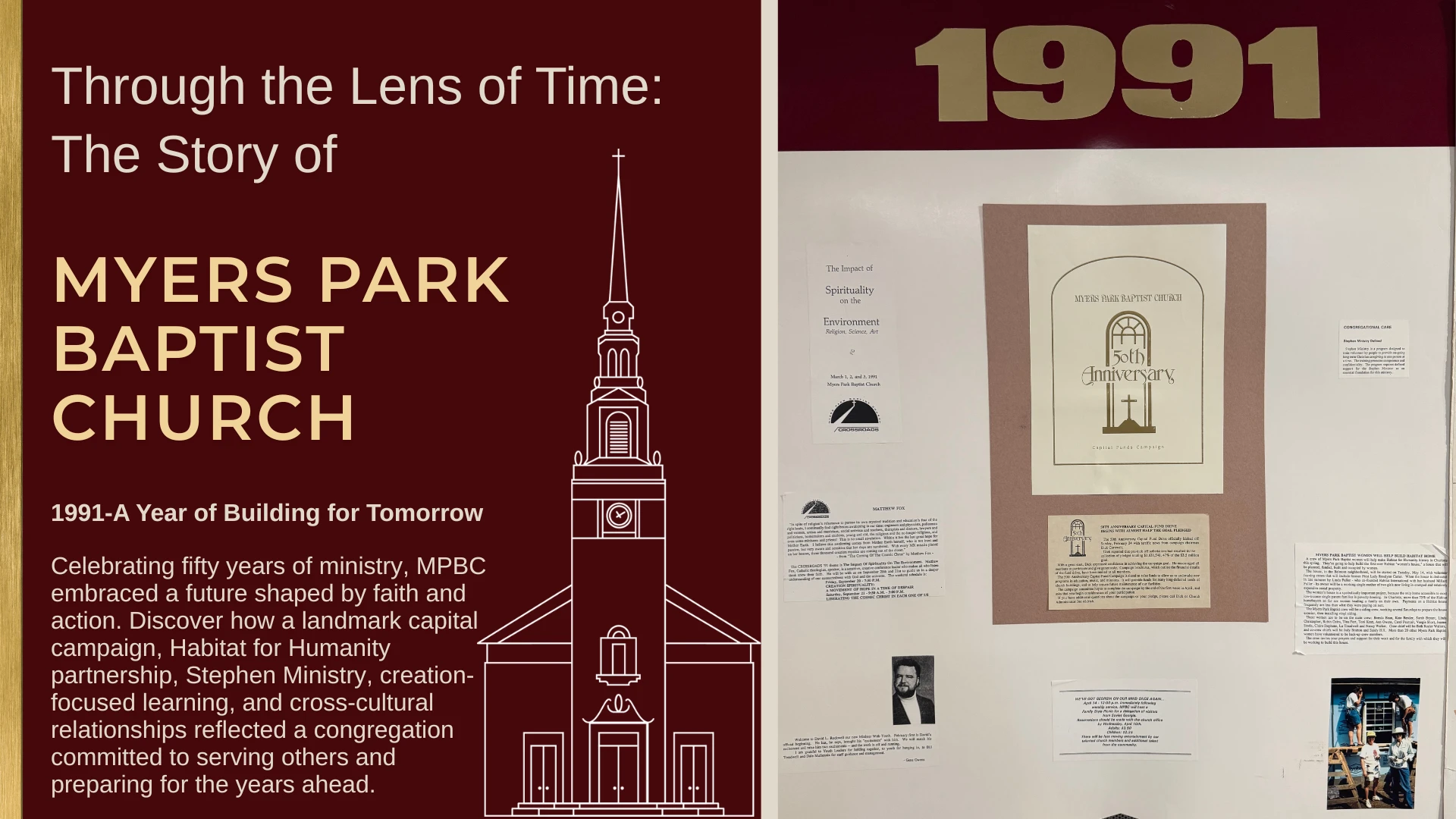
1991 - A Year of Building for Tomorrow
50th Anniversary: A Church Living Its Jubilee Vision
In 1991, as Myers Park Baptist Church celebrated its fiftieth anniversary, the congregation found itself reflecting on a remarkable legacy while preparing for an even greater future. This was a year marked by vision and action, as members invested in facilities, strengthened ministries, cared for neighbors, welcomed new leadership, and expanded relationships both locally and internationally. From building a Habitat for Humanity home to launching Stephen Ministry and exploring faith's connection to creation, the church continued to demonstrate that faithful stewardship is about more than preserving the past. It is about responding to God's call in the present while preparing the way for generations yet to come.
Investing in the Future
As Myers Park Baptist celebrated its 50th Anniversary, the congregation launched an ambitious Capital Fund Campaign with remarkable early success. Through advance solicitations, Campaign Chair, Dick Cornwell, announced that the church had already received $1,631,540 in commitments, representing nearly half of the campaign’s ambitious $3.5 million goal before the public launch. Supported by Joe Aldrich, the campaign envisioned more than building improvements. It sought to strengthen ministries in education, music, and missions, while ensuring the long-term care of the church's facilities for future generations. The campaign framed stewardship as an investment in ministry—not simply about buildings, but about providing space and resources that would strengthen the church's ministries and support future generations..
Women Building Justice with Habitat for Humanity
Perhaps no ministry better illustrated the congregation's commitment to justice than its partnership with Habitat for Humanity. A team of Myers Park Baptist women joined the construction of Charlotte's first Habitat "Women's House," a landmark project planned, funded, built, and ultimately owned by women. The home provided stable housing for a working single mother and her two daughters.
The project brought together an extraordinary team of volunteers, including: Brenda Bean, Kate Bender, Sarah Bryant, Linda Christopher, Robin Coira, Tina Fort, Toni Kratt, Ann Owens, Carol Pearsall, Veegie Short, Jeanne Steele, Claire Stephens, Lu Treadwell, and Nancy Walker.
Leadership for the project was provided by Beth Resler Walters, with Judy Bratton and Sandy Hill serving as co-crew chiefs, while more than twenty additional women volunteered as substitute crew members. The project connected Myers Park Baptist with national Habitat leaders, including Rosalynn Carter, who joined the framing crew, and Linda Fuller, who co-founded Habitat alongside her husband Millard Fuller. Their work reflected the church's longstanding commitment to economic justice, community partnership, and deep compassion for helping families build stable futures.
The significance of this project reached far beyond the construction of a single house. At the time, many low-income single-parent families had few housing options beyond substandard or poverty-level housing. Habitat for Humanity offered a pathway to stability and homeownership, often with monthly payments that were lower than what families had been paying in rent. In Charlotte, more than 75 percent of Habitat homebuyers were women serving as the sole heads of their households, making the Women’s House initiative especially meaningful.
Compassion Through Stephen Ministry
During this season of growth and ministry development, Myers Park Baptist Church introduced Stephen Ministry, a compassionate program dedicated to training and equipping volunteer laypersons to provide ongoing, one-to-one Christian care for individuals experiencing difficult seasons of life. Grounded in the belief that every person deserves a caring presence during times of grief, illness, loss, transition, or personal struggle, the ministry sought to extend Christ’s love through meaningful relationships and faithful support.
Stephen Ministers were carefully selected and thoroughly trained to serve as compassionate caregivers, offering a listening ear, encouragement, prayer, and a steady presence to those in need. Rather than providing short-term assistance, these volunteers committed themselves to walking alongside individuals over an extended period, offering support that was both personal and consistent.
From its inception, the ministry emphasized two essential principles: competence and confidentiality. Comprehensive training helped volunteers develop the skills necessary to provide effective Christian caregiving, while a strong commitment to confidentiality created a safe and trusting environment for those receiving care. These foundational values ensured that the ministry would be both credible and compassionate, reflecting the church’s commitment to excellence in pastoral care.
The introduction of Stephen Ministry represented an important expansion of the congregation's ministry of care, offering hope, encouragement, and Christ-centered support through relationships built on trust and compassion. By empowering dedicated laypersons to share in the ministry of compassion, Myers Park Baptist strengthened its ability to respond to the emotional and spiritual needs of its members and community.
Caring for Creation as an Act of Faith
As part of its ongoing commitment to exploring the relationship between faith, spirituality, and the world around us, Crossroads Ministry presented a thought-provoking series centered on the theme “The Impact of Spirituality on the Environment.” Bringing together perspectives from theology, science, and the arts, the event reflected a growing conviction that care for creation is central to Christian discipleship. The featured speaker, Catholic theologian, Matthew Fox, challenged participants to rediscover what he called creation spirituality—a faith grounded in wonder, interconnectedness, and responsibility for the Earth. Drawing from his book, "The Coming of the Cosmic Christ" Fox invited the congregation to see environmental stewardship not simply as a political concern, but as a deeply spiritual calling. His presentations, "Creation Spirituality: A Movement of Hope in a Time of Despair" and "Liberating the Cosmic Christ in Each One of Us," encouraged participants to recognize God's presence throughout creation and to respond with justice, imagination, and hope.
Building Bridges Across Borders
Continuing relationships established through previous international ministry efforts, Myers Park Baptist welcomed a delegation of visitors from the nation of Georgia during the final years of the Soviet era. The church hosted a family-style picnic featuring music and entertainment from both church members and community performers. The meal became another expression of the church's conviction that breaking bread together can help overcome fear, nurture understanding, and strengthen relationships across cultures.
Welcoming New Leadership with Youth
The congregation joyfully welcomed David L. Rockwell as its new Minister with Youth. Dr. Gene Owens celebrated David's enthusiasm while expressing heartfelt gratitude to the many people who sustained the youth ministry during the pastoral transition. He thanked the youth themselves, volunteer leaders, Bill Treadwell, and Dale Mullennix for their faithful leadership and commitment. The warm welcome reflected the congregation's belief that ministry is a shared calling, built not only by clergy but by dedicated volunteers, families, and young people themselves.
As the year came to a close, Myers Park Baptist stood at a unique crossroads between gratitude and anticipation. Fifty years of ministry had provided a strong foundation, yet the congregation's focus remained firmly on the future. Through a successful capital campaign, partnerships that extended beyond church walls, ministries of compassion and care, and a renewed commitment to nurturing relationships across communities and cultures, the church demonstrated that its strength was found not simply in its buildings or programs, but in its willingness to follow God's leading wherever it might go. The story of 1991 is ultimately one of a congregation building, not only with bricks and mortar, but with faith, vision, and hope for the years ahead.