
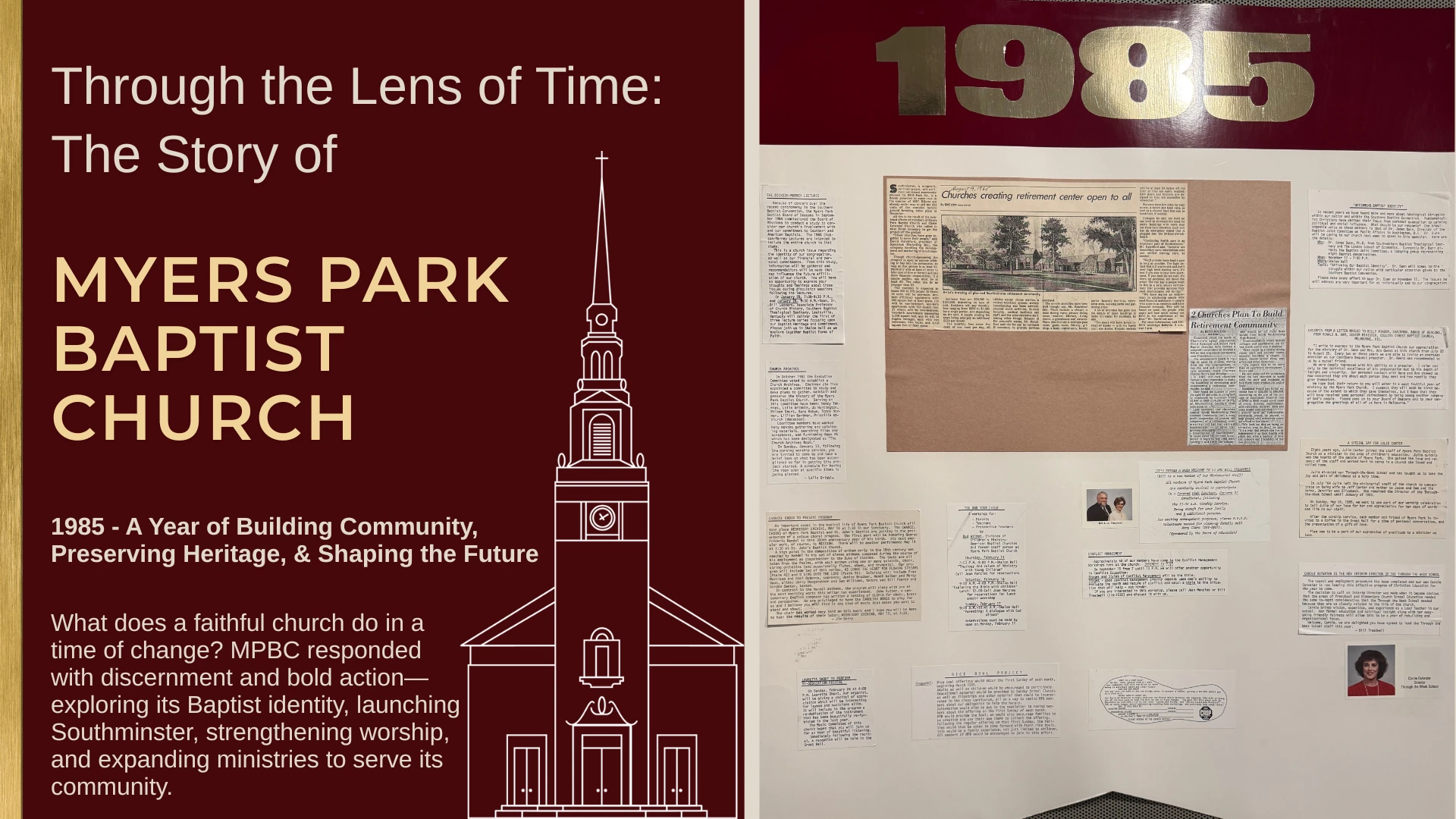
1985 - A Year of Building Community, Preserving Heritage, and Shaping the Future
What does a faithful church do when faced with change, opportunity, and pressing human need all at once? In 1985, Myers Park Baptist Church responded with thoughtful discernment and bold action—engaging complex questions about Baptist identity, launching an ambitious vision for senior care through Southminster, preserving its history, enriching worship through music, and expanding its commitment to feeding the hungry, educating families, and strengthening leadership for the future.
Courageous Conversations About Baptist Identity
Amid growing tensions and controversies within the Southern Baptist Convention, Myers Park Baptist undertook a thoughtful process of discernment regarding its Baptist heritage and future affiliations. The Board of Deacons commissioned a study examining the church's relationship with Southern and American Baptist organizations.
As part of this effort, the 1985 Dickson-Marney Lectures invited the entire congregation into prayerful reflection and dialogue. Historian Bill Leonard, then Associate Professor of Church History at Southern Baptist Theological Seminary, led discussions on "Baptist Forms of Faith." The lectures encouraged members to consider how Baptist traditions of freedom, conscience, and local church autonomy might guide the congregation's future. This process demonstrated the church's commitment to thoughtful engagement rather than simple institutional loyalty.
A Vision of Compassion: Southminster Retirement Community Takes Shape
One of the most ambitious ministries undertaken by the congregation was the creation of South Mecklenburg Retirement Community, Inc., which would become Southminster. Working in partnership with Christ Episcopal Church, Myers Park Baptist helped launch a continuing-care retirement community designed to meet the growing needs of older adults in Charlotte.
Leadership from both churches envisioned more than housing; they sought to create a community marked by dignity, friendship, security, and spiritual care. Board Chairman Thomas Storrs emphasized that church volunteers would remain actively involved in residents' lives.
Plans included apartments, cottages, health-care facilities, a pharmacy, beauty parlor/barber shop, central kitchen, dining rooms, a chapel, library, gardens, walking paths, a gift shop, and social spaces, all designed to support independent living while providing compassionate care when needed. A particularly noteworthy commitment was the creation of an endowment fund to assist residents facing financial hardship, reflecting the congregation's concern for justice and accessibility as well as comfort.
Preserving the Story of a Faithful Congregation
A new chapter in preserving congregational memory began with the establishment of the Church Archives. Under the leadership of Chairman Jim Tice and committee members Lalla Gribble, Nancy Tennies, Jo Huntington, Milton Short, Sara Rabun, Tommy Norman, Lillian Gardner, and Priscilla Upchurch, volunteers spent countless hours collecting documents, photographs, records, and memorabilia that told the story of Myers Park Baptist Church.
The project reflected a growing appreciation for the congregation's history and a desire to preserve its legacy for future generations.
Music that Inspires the Soul
The music ministry flourished in 1985 through a series of special performances and celebrations. Under the direction of Jim Berry, the Chancel Choir joined with the choir of St. John's Baptist Church to honor the 300th anniversary of George Frideric Handel.
The concerts featured selections from Handel's Chandos Anthems with soloists Fran Morrison and Gini Osborne (sopranos), Janice Bradner, Renee Walker and Mandy Vann (altos), Jerry Hoogenakker and Sam Williams (tenors) and Bill Pearce and Gordon Senter, (bass). The program culminated with Gloria by John Rutter, accompanied by the Carolina Brass.
The church also celebrated its renewed organ through a recital by organist Lauretta Short, marking the rededication of the beautifully refurbished instrument. These events highlighted the congregation's long-standing commitment to excellence in worship and the arts.
Answering Christ's Call to Feed the Hungry
The proposed Rice Bowl Project offered a practical and spiritual response to world hunger. Designed as a monthly offering involving both children and adults, the initiative encouraged families to collect donations in bowls and bring them forward during worship. Educational materials, filmstrips, and Sunday School resources accompanied the project, helping members connect faith with action on behalf of those experiencing hunger. The proposal reflected a growing awareness that Christian discipleship includes concrete acts of compassion and justice.
Myers Park Baptist Church also came together for the Crop Walk by donating, walking, and pledging money per mile to support participants. The Board of Missions strongly endorsed Church World Services which organized the walks and believed this to be one of the most effective ways to address hunger.
The goal was to raise $100,000, with 25% supporting local partners—Loaves and Fishes and Crisis Assistance Ministry—and the remaining 75% directed toward global hunger relief including efforts emphasizing teaching farm technology and long-range relief and sustainability.
Workshops for Parenting, Teaching, and Managing Conflict
Myers Park Baptist Church continued its dedication to equipping families and educators. Parents, teachers, and prospective teachers were invited to a series of workshops with Bud Wilmot from Division of Children's Ministry, American Baptist Churches, and a former MPBC staff member.
Workshops included: "Theology and Values of Ministry with Young Children," "Exploring the Bible with Children," and "Parenting: A Dialogue with Bud Wilmot."
Conflict Management workshops remained popular and drew strong attendance. In September, members participated in a session on Stages and Styles of Conflict Management. learning that effective conflict resolution depends on the ability to assess both the depth and nature of conflict and to respond with an appropriate style that helps rather than hinders.
Extending a Warm Welcome to New Leadership
The congregation formally welcomed William C. Treadwell, Jr. and his wife Louise Johnson Treadwell with a churchwide covered-dish luncheon. Rev. Treadwell had been called to serve as Senior Educator and Staff Coordinator following the staff restructuring announced the previous year.
Church leaders anticipated that his experience in Christian education, administration, and congregational planning would strengthen the church's ministries and help coordinate its growing programs. The enthusiastic welcome demonstrated the congregation's support for collaborative leadership and educational ministry.
At the same time, the church marked a transition in children's ministry leadership. After eight years of service as minister in the area of children's education and Director of Through-The-Week School, Julie Carter stepped away from her role on the ministerial staff in order to spend time with family. She remained as Director of Through-the-Week School while a search for a replacement began.
Julie had gained the love and respect of staff, families, and children, teaching that it was important to take the joy and pain of childhood as a holy time. A special celebration in her honor was held during worship and followed by a gathering in the Great Hall (now Heaton Hall).
Through-The-Week School Lead Teacher, Carole Outwater was called as Interim Director. She was a natural choice to lead both Preschool and Elementary Church School Education; areas closely connected to the life of the church and deserving thoughtful attention. Carole brough wisdom, expertise, and experience along with spiritual insight and a gracious, even-handed leadership style that would guide a season of rebuilding and renewed organizational focus.
A Year That Shaped What Was to Come
Looking back, 1985 reveals a congregation engaged in both faithful reflection and meaningful action. Whether wrestling with denominational identity, launching visionary ministries, addressing human need, or nurturing the next generation, Myers Park Baptist Church demonstrated a willingness to listen deeply and respond courageously.
The threads woven throughout this year—discernment, compassion, collaboration, and a commitment to justice—continue to echo in the life of the church today. In 1985, the people of Myers Park Baptist were not simply preserving a legacy; they were actively shaping it, leaving a witness that faith calls us not only to believe, but to engage the world with wisdom, courage, and love.