
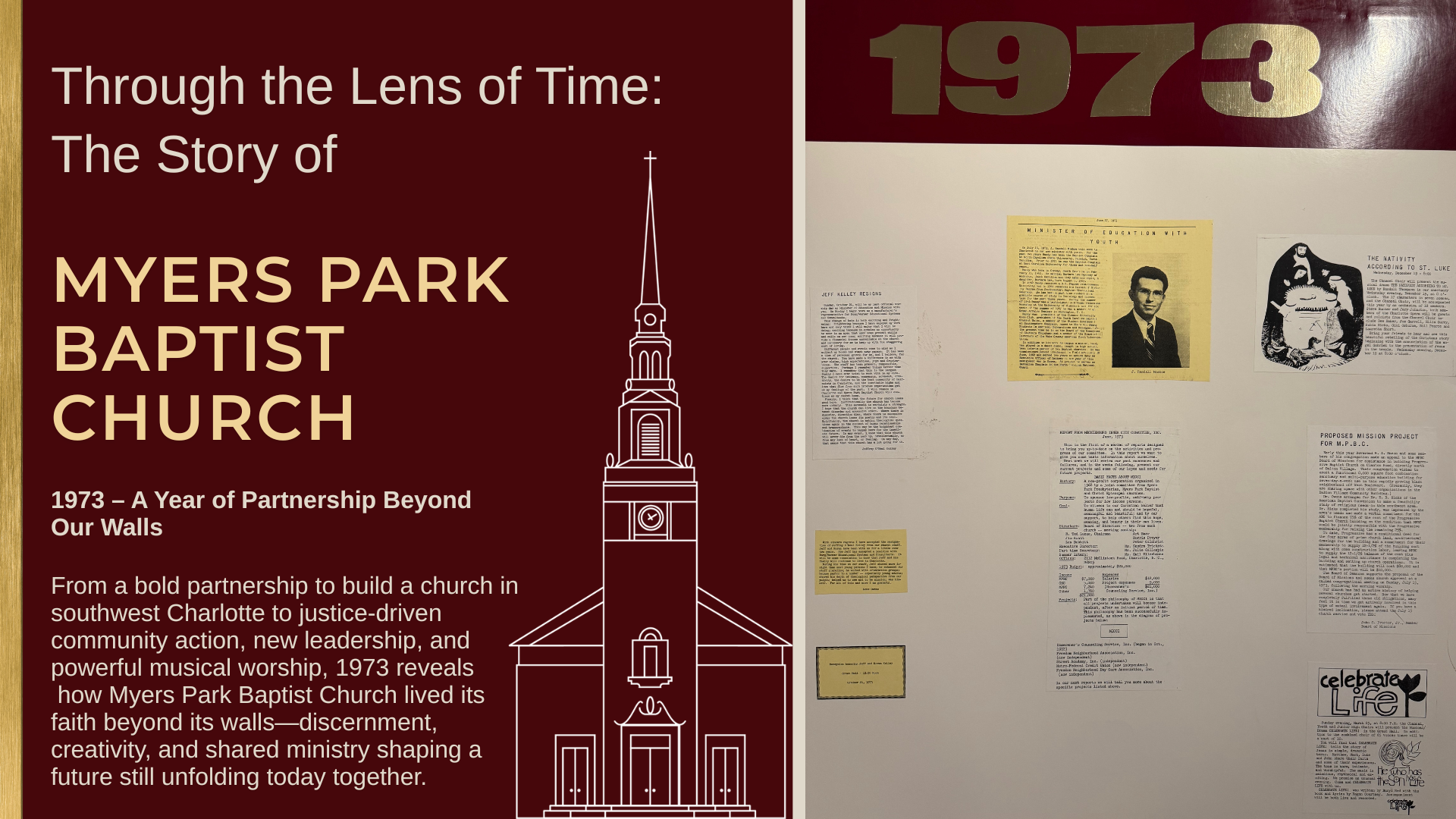
1973 - A Year of Partnership Beyond Our Walls
In 1973, Myers Park Baptist Church stood at the intersection of faith and action—considering a bold partnership to help build a church in southwest Charlotte, continuing hands-on justice work through Mecklenburg Inner City Community, Inc., welcoming new leadership, and giving voice to scripture through powerful musical drama. From boardroom conversations about shared ministry on Clanton Road to choirs filling the Great Hall and Sanctuary with song, this was a year when belief took shape in tangible, communal ways—revealing a congregation actively discerning how to live the gospel in its time and place.
Partnering to Help Build Another Church
In 1973, the congregation considered a significant partnership with Progressive Baptist Church in a growing Black neighborhood off West Boulevard. At the time, Progressive Baptist Church had been sharing space with other organizations in the Dalton Village Community Building. Their pastor, Rev. R. A. Macon, along with members of the congregation, appealed to MPBC’s Board of Missions for assistance in building a functional 8,000-square-foot combination sanctuary and multi-purpose education building for seven-day-a-week use on Clanton Road.
Dr. Owens arranged for Dr. E. B. Hicks of the American Baptist Convention (ABC) to conduct a feasibility study of religious needs in this southwest area of Charlotte. Dr. Hicks was deeply impressed by what he found and made a verbal commitment for ABC to finance 75% of the project’s cost—on the condition that MPBC and Progressive Baptist Church would jointly raise the remaining 25%.
The total cost of the building was estimated at $80,000. MPBC’s portion would be $10,000, along with legal and technical assistance to help complete the building and establish church operations. In a message to the congregation, Johns S. Proctor, Jr., a member of the Board of Missions, shared that the Board of Deacons supported the proposal and would seek church approval at a called congregational meeting.
Myers Park Baptist Church had a long and active history of helping other churches get started and had faithfully fulfilled those commitments. In this moment, leaders and members alike felt it was time to step forward once again. This partnership reflected MPBC’s enduring belief in shared ministry—walking alongside neighboring congregations in mutual support rather than charity.
Living Faith Through Community Action: Mecklenburg Inner City Community, Inc. (MICCI)
Founded in 1968 through collaboration between Myers Park Baptist Church, Myers Park Presbyterian Church, and Christ Episcopal Church, Mecklenburg Inner City Community, Inc. (MICCI) continued its vital work in 1973. The organization focused on supporting self-help initiatives in low-income communities throughout Charlotte.
MICCI’s stated goal was “to witness to [their] Christian belief that human life can and should be hopeful, meaningful, and beautiful; and by [their] support, to help others find this hope, meaning, and beauty in their own lives.” Central to MICCI’s philosophy was the conviction that all projects would become independent after an initial period of support.
By 1973, several initiatives had been successfully implemented, including: Homeowner’s Counseling Service, Inc.; Freedom Neighborhood Association, Inc.; Street Academy, Inc.; Metro-Federal Credit Union; and Freedom Neighborhood Day Care Association, Inc. Together, these efforts embodied a practical expression of Christian hope—faith lived through justice-centered, community-rooted action.
Welcoming Rev. J. Randall Mishoe
In July 1973, Rev. J. Randall “Randy” Mishoe joined the staff as Minister with Youth. Previously a chaplain at North Carolina State University and East Carolina University, Randy brought a thoughtful campus ministry perspective shaped by his education at Clemson University and Southeastern Baptist Theological Seminary.
He had been named to "Who's Who Among Students in American Universities and Colleges" and at the time was serving on the Board of the Committee of Southern Churchmen and on Board of Directors of the Wake County American Civil Liberation Union. His involvement in human relations work and civil liberties advocacy reflected our congregation’s growing commitment to social awareness and justice engagement.
Randy, his wife Barbara, and their daughter, Barbara Lee, were warmly welcomed into the life of Myers Park Baptist Church.
Gratitude and Transition: Jeffrey O’Neal Kelley
In October 1973, Jeffrey O’Neal Kelley announced his resignation from his role as Minister of Education and Mission. While the news was met with mixed emotions, Jeff shared his excitement about applying the skills he had developed at Myers Park Baptist Church to new challenges in his next position with Borg/Warner Educational Systems and Consultants.
Jeff was celebrated for strengthening theological conversations within the congregation, nurturing young adults, and encouraging the church to live creatively “between disorder and excessive order.” Dr. Owens, the staff, and the congregation expressed deep gratitude for his leadership and rejoiced that Jeff would remain part of the MPBC and Charlotte community.
Expanding Worship Through Music and Drama
Celebrate Life
On a Sunday evening in late March, all were invited to gather in the Great Hall (now Heaton Hall) for a musical drama performance of Celebrate Life. The Chancel, Youth, and Junior High choirs combined to form a 65-voice choir, joined by a cast of ten performers.
Celebrate Life is a warm, intimate, and worshipful retelling of the story of Jesus, told in simple, dramatic terms. Matthew, Mark, Luke, and John appear as characters, sharing their faith and experiences. The work was written by Buryl Red, based on the book and lyrics by Ragan Courtney
The Nativity According to St. Luke
Later that year, the Chancel Choir presented The Nativity According to St. Luke by Randall Thompson. Accompanied by an orchestra of twelve, the performance included seventeen characters and featured guest soloists Steve Bunker and Jary Johnston from the Charlotte Opera.
Soloists from the Chancel Choir included Dee Eaker, Joe Garrell, Ellis Gurry, Robin Hicks, Gina Osborne, Bill Pearce, and Lauretta Short.
The musical followed the biblical text of the Nativity story, set in the Holy Land during the age of Augustus. It began with the angel Gabriel’s announcement of Jesus’ birth and unfolded across seven scenes, including the visitation of Mary, the naming of John, and the presentation of Jesus in the temple. The work concluded with the shepherds’ visit to the manger and the arrival of the wise men.
Together, these musical offerings reflected a vibrant worship life grounded in scripture, storytelling, and artistic excellence.
A Year That Still Speaks
Looking back on 1973, it becomes clear that Myers Park Baptist Church was quietly shaping its future through deliberate, faithful choices. That year brought thoughtful conversations about partnering with Progressive Baptist Church to build a shared ministry presence in southwest Charlotte, continued investment in justice-oriented community work through Mecklenburg Inner City Community, Inc., and moments of transition and welcome within the church staff. These decisions, alongside rich expressions of worship through music and drama, reveal a congregation listening closely—to its neighbors, to scripture, and to the call to live its faith in tangible, relational ways. Even decades later, these stories remind us that Myers Park Baptist Church has long been shaped by a faith that seeks connection, courage, and hope—commitments that continue to guide who we are today.