
1971 - A Year of Shared Sacred Spaces and Dedication to Child Development
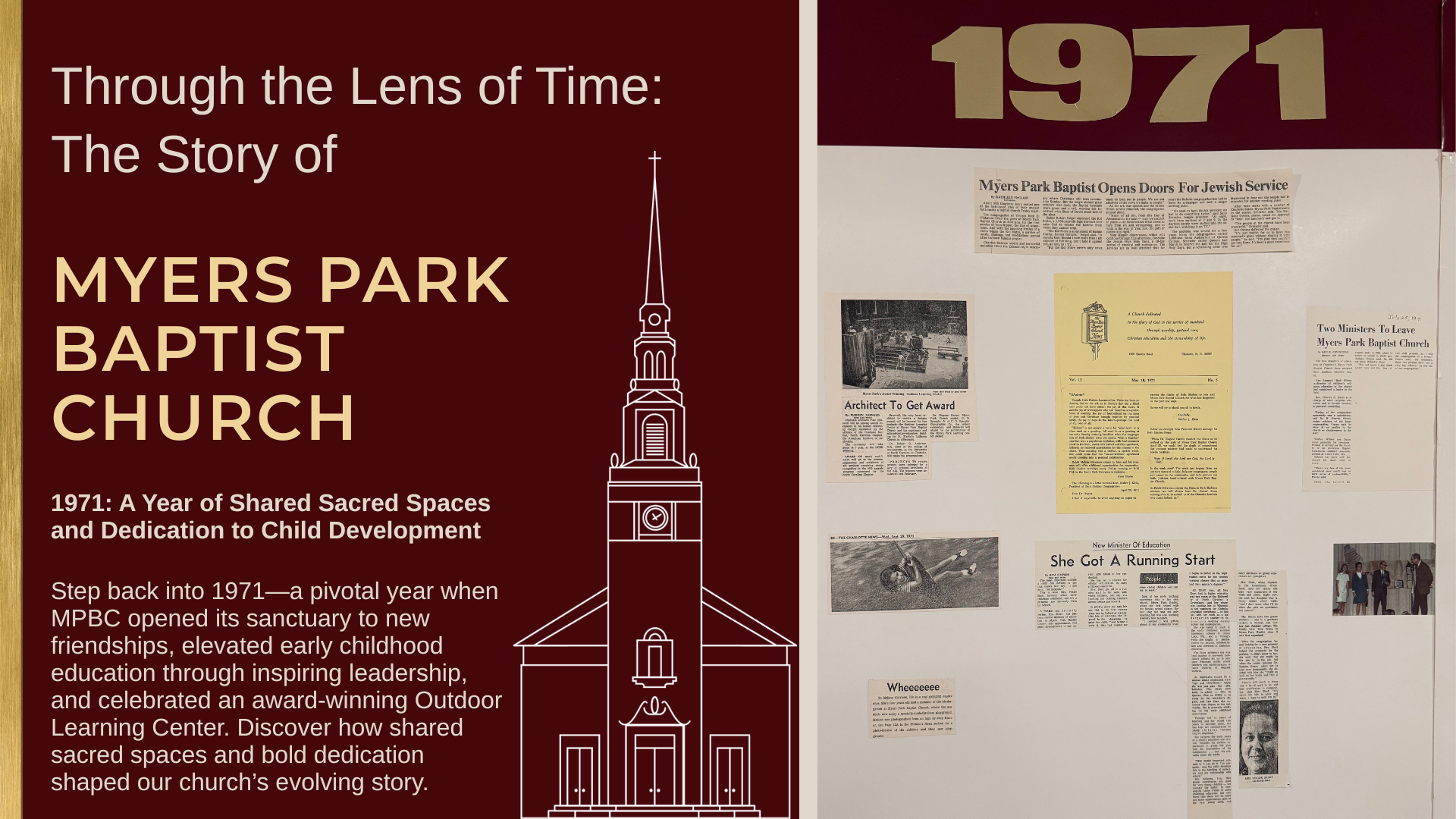
In 1971, Myers Park Baptist Church lived out its calling in ways both bold and tender. It was a year marked by unexpected interfaith hospitality, visionary leadership in childhood education, and recognition for creating spaces that nurtured wonder. From welcoming our Jewish neighbors on their holiest night to empowering a gifted educator and opening an award‑winning Outdoor Learning Center, 1971 revealed a church moving with courage, generosity, and imagination. This chapter captures a season when welcome, wisdom, and good design came together to deepen our life together.
Interfaith Welcome: Yom Kippur at Myers Park Baptist
“About 900 Charlotte Jews recited one of the best-loved rites of their ancient faith inside a Baptist church Friday night,” The Observer reported in 1971. A scheduling error had left Temple Beth El V’Shalom without its usual venue for Yom Kippur services at Dana Auditorium at Queens College. In a decisive act of neighborly grace, Rev. Dr. Gene Owens sought approval to “loan” our sanctuary—and received it. As he put it, “It’s just foolish for us to have this mammoth place without sharing it with people. I’m glad they couldn’t get Dana. It’s been a good experience for us.”
That Friday evening at 8:30 p.m., Temple Beth El V'Shalom filled our Colonial-style sanctuary for the first service of Yom Kippur, the Day of Atonement. Hebrew chanting and sorrowful melodies echoed in the same space where Christians would receive communion two days later. The stained-glass window was left dark; hymnals were removed; a tall wooden ark inscribed with Stars of David stood behind the altar. Rabbi Robert Seigel explained the spiritual weight of the Kol Nidre prayer—a humble plea for release from vows made earnestly to God but beyond human capacity to keep. The service marked a profound moment of reverence, shared humanity, unexpected connection—an unforgettable evening of welcome.
A Friendship Takes Root: Temple Beth Shalom Finds a Home
What began as an urgent accommodation in 1971 blossomed into a meaningful partnership. Myers Park Baptist soon offered the Youth Hall—now Shalom Hall—for Temple Beth Shalom’s regular Friday evening services. Rabbi Melvin Silverman arrived that June to foster this growing interfaith collaboration. Our congregation extended an invitation to share Sunday breakfast, cementing the warmth between the two faith communities.
Rev. Dr. Eugene Owens later reflected, “What a togetherness that was. One could sense that the ‘use-of-facilities’ agreement would develop into a personal relationship.”
Walter J. Klein, President of Beth Shalom Congregation, expressed deep gratitude in a letter to the church:
“I find it impossible to write anything on paper to express the thanks of Beth Shalom to you and Myers Park Baptist Church for what has happened in the past few days. So, we will try to thank you all in deeds.”
In correspondence to the Temple Beth Shalom congregation, he recalled a moment that shaped their bond and would carry forward:
When Dr. Eugene Owens shouted the Shema as he walked up the aisle of Myers Park Baptist Church April 25, we could feel the depth of commitment this eminent minister had made to understand his Jewish brethren. Now we can turn outward to help—help our congregants, people and causes in the community, and help nurture faith, Judaism, hand‑in‑hand with Myers Park Baptist Church. As Rabbi Silverman recites the Shema in Beth Shalom’s services, we will always here Dr. Owens’ Shema echoing after it, to remind us of the Christian brothers who stand behind us.
What the partnership made clear then—and still affirms—is that sharing sacred space can shape sacred relationships.
Spotlight on Education: Mrs. Veegie Short
Some leaders emerge from classrooms long before they carry a title. For Mrs. Veegie Short, it began when she brought her son, Hal, to his first nursery class at Myers Park Baptist. When he resisted, she lingered to calm him; soon, other infants were placed in her arms. From there she moved from teaching to training teachers—discovering a vocation that would bless generations.
After two years at the University of North Carolina at Greensboro, Mrs. Short deepened her expertise through Christian education workshops in Wisconsin sponsored by MPBC to support her work in the church’s weekday nursery school and kindergarten. Her gifts led to teaching in the early childhood summer laboratory schools of Green Lake, Wisconsin, and later in Pennsylvania, where she worked with pastors, administrators, and directors of Christian education. She served as lead teacher in a laboratory school preparing Wisconsin public school teachers and administrators to serve the children of migrant workers—evidence of both skill and heart.
Sensing that her experience had outpaced her credentials, she returned to school at age 45 with the unwavering support of her husband, City Councilman Milton Short and their two children Gay and Hal. She attended Queens College and then UNCC where she earned her bachelor’s degree and early childhood certification. Over eleven years of teaching and two years of full‑time study, her vision remained the same: center on the youngest learners. “The early years of a child’s education are critical,” she insisted, “because their earliest experiences in group life give them impressions of their competence and their attitudes about the world.” She believed the earlier the group experiences begin, the better—and foresaw expanding opportunities for very young children.
When MPBC began searching for a new Minister of Education after the departures of Rev. Leonard “Bud” Wilmot and Rev. Charles D. Davis, it was natural for Dr. Owens to ask Mrs. Short to serve—at first thought, temporarily—but they quickly agreed that she would take the position permanently. In that role, she championed confidence‑building as the cornerstone of Christian formation, helping children claim the resilient posture of “I can do it; I’m adequate.” Her appointment signaled our church’s deep, ongoing commitment to nurture young minds and hearts.
Spaces that Teach: An Award‑Winning Outdoor Learning Center
Visionary education requires spaces worthy of children’s curiosity. Myers Park Baptist’s Outdoor Learning Center, designed by architect Paul Braswell, received an Award of Merit from the North Carolina Chapter of the AIA—Braswell was the only Charlotte architect honored that year, recognized both for our Outdoor Learning Center and for the sanctuary and administration‑education building at St. Martin’s Lutheran Church in Albemarle.
The recognition, presented by Dr. Robert G. Anderson of UNCC with contractor C. D. Spangler Jr. and architect Braswell, affirmed that our investment in design excellence was more than aesthetic—it was form in service of formation.
The Charlotte News highlighted the announcement with a photograph of the center and a joyful image of four‑year‑old Melissa Garrison, a kindergarten student at MPBC, soaring on a swing in the specially designed playground. The picture captured the heart of the project: a church building the kind of place where faith, play, learning, and the sacred work of nurturing children naturally meet.
Closing Reflections: The Shape of Our Welcome
Looking back, 1971 stands as a testament to the best of who we are. This season in our story reveals a consistent pattern: we open what we have so others can flourish. We opened our sanctuary and discovered interfaith friendship; we opened opportunities for a gifted educator, and strengthened the formation of our children; we opened spaces designed for growth, and watched imagination take flight. Together, these moments—Yom Kippur under our roof, Mrs. Veegie Short’s faithful leadership, and an award‑winning learning environment—tell the same truth: when we share generously, community deepens, children thrive, and God’s love becomes visible in the life we build together.