
1970: The Year the Dam Broke for Women's Leadership
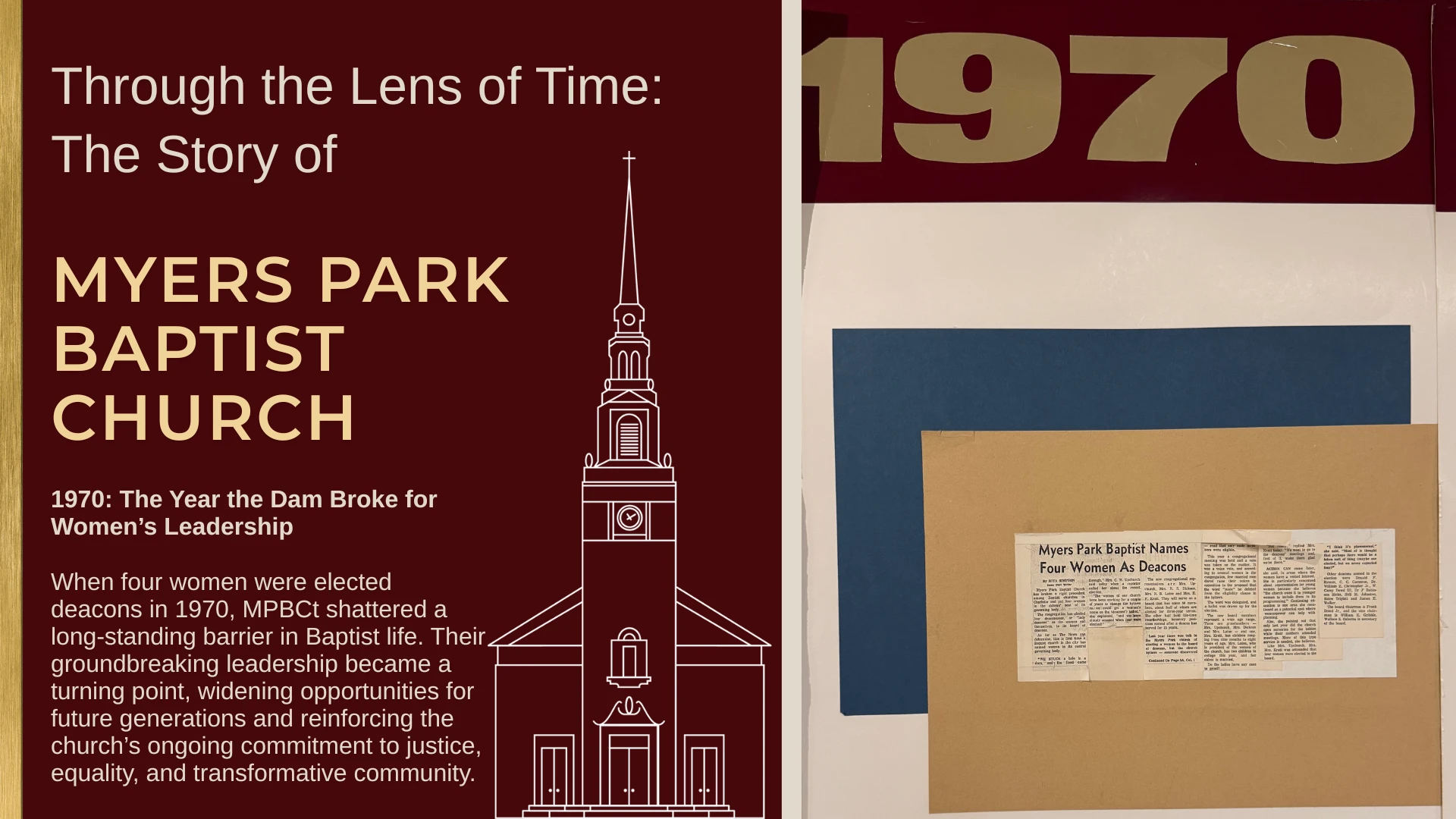
On the timeline board for 1970, a single story was posted. Perhaps because it was impactful enough that it deserved to stand on its own. In 1970, Myers Park Baptist Church stepped boldly into the future—another chapter in its long, intentional journey toward equality, inclusion, and authentic community. The seeds of gender equity had been quietly taking root for years, nurtured by women who believed deeply in the church’s capacity for growth and transformation. That year, those convictions broke through a longstanding barrier in dramatic fashion. As The News reported, “Myers Park Baptist Church has broken a rigid precedent among Baptist churches in Charlotte and put four women in the drivers’ seat of its governing body.” The election of four women to the Board of Deacons marked a defining milestone, one that echoed far beyond the walls of the Sanctuary. It was, quite literally, the moment the dam broke.
The newspaper story—headlined “Myers Park Baptist Names Four Women as Deacons”—captured the magnitude of what had happened. Mrs. C. W. Upchurch, Mrs. R. S. Dickson, Mrs. R. B. Laine, and Mrs. E. F. Kratt were the trailblazers elected. Reflecting on the moment, Mrs. Upchurch offered a vivid metaphor that perfectly described both the struggle and the triumph: “We stuck a hole in a dam, and the flood came through.”
For years, the church bylaws limited service on the Board of Deacons to men only. But the women of the church were determined to change that word—and the world behind it. After sustained effort and quiet advocacy, their moment arrived. At a congregational meeting where the proposed bylaw change was presented, “few married men dared raise their voices in opposition to the proposal that the word ‘male’ be deleted from the eligibility clause.” With that single deletion, the path opened. A ballot was prepared with the hope of electing at least one woman. Instead, the congregation elected four.
These four women represented a wide spectrum of ages and life experiences. Three—Mrs. Upchurch, Mrs. Dickson, and Mrs. Laine—were grandmothers. Mrs. Kratt was a younger mother with children ranging from nine months to eight years old. Mrs. Laine also served as president of the women of the church and was parenting children in multiple life stages, including two in college and one already married. They brought not only dedication but generational perspective, leadership experience, and a keen awareness of the needs facing women across the church.
When asked whether they had any “axes to grind,” Mrs. Kratt responded with characteristic grace and clarity: “Not really. We want to go to the deacons’ meetings and first of all, make them glad we’re there. Action can come later in areas where the women have a vested interest.” Among those priorities was stronger representation for younger women. The group believed “the church owes it to younger women to include them in its programming,” especially in areas like continuing education, where womanpower could strengthen and expand the church’s work. They also noted that childcare had only become available the previous year, enabling mothers to attend meetings—an accessibility milestone as significant to the church’s future as the bylaw amendment itself.
The 1970 election also included several other deacons: Donald F. Bynum, C. C. Cameron, Dr. William E. Christopher, Jr., W. Carey Dowd III, Dr. J. Robinson Hicks, Hall M. Johnston, Boice Triplett, and James E. Walker. The board was chaired by Frank Dowd, Jr., with William E. Gribble serving as vice chair and Wallace S. Osborne as secretary.
The election of these four women was far more than an administrative update—it was a statement about who Myers Park Baptist Church was becoming. It affirmed that leadership is strengthened, not threatened, by diversity. It recognized the spiritual gifts and wisdom of women who had long shaped the life of the church from the pews, classrooms, and committees. And it sent a signal to the wider community that MPBC would not be bound by outdated precedents when justice and equality were calling.
In many ways, 1970 was a watershed year. By breaking through the dam of tradition, these four women widened the river for all who would follow—laying the groundwork for the more inclusive and equitable community MPBC continues striving to be today. Their courage, persistence, and faith-filled leadership remind us that transformation often begins with a single word removed, a single vote cast, or a single voice saying, “The time has come.” And once the flood begins, the future rushes in.