
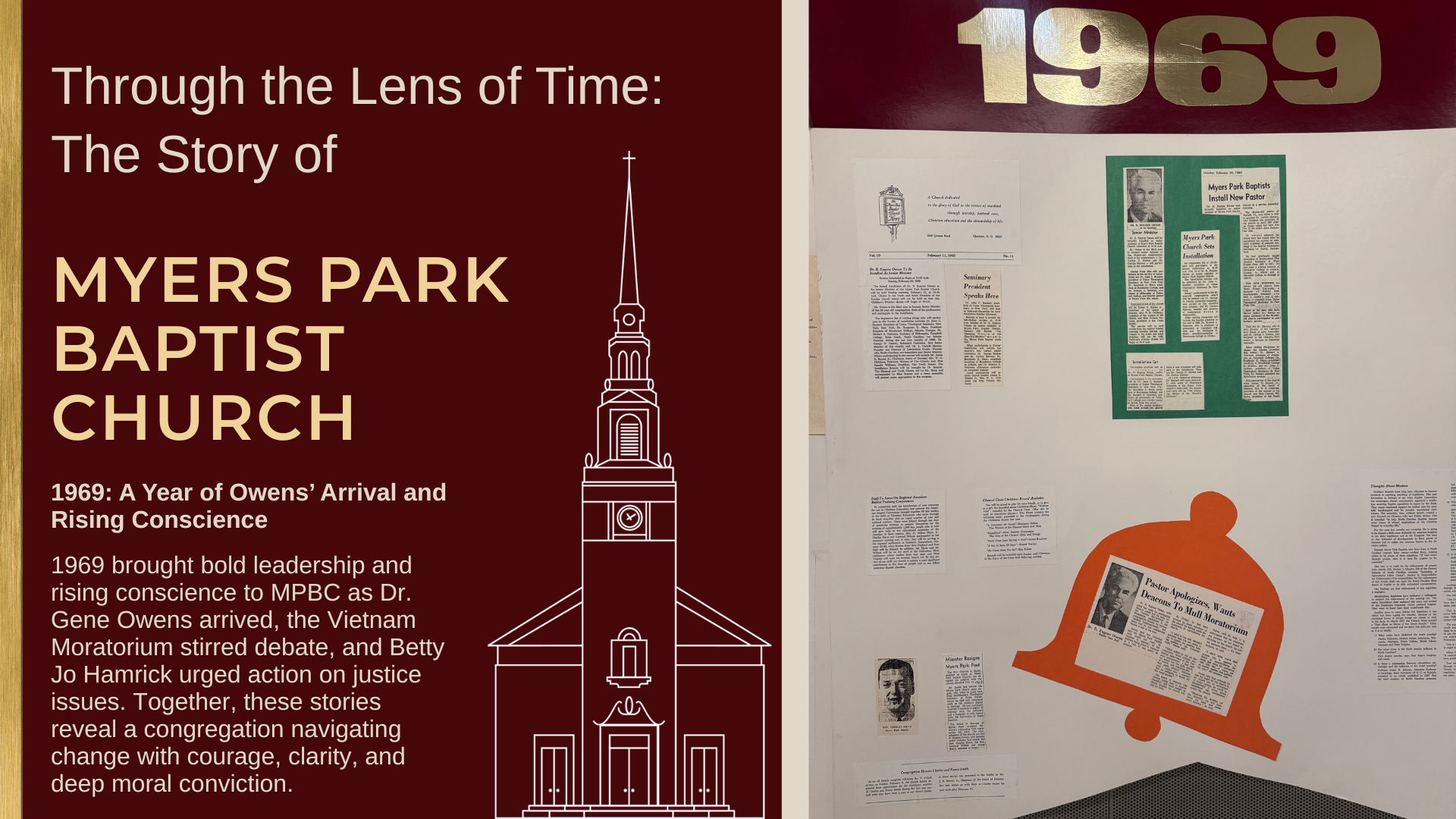
1969: A Year of Owens' Arrival and Rising Conscience
1969 arrived with a sense of momentum at Myers Park Baptist Church—a year when joys and challenges intertwined, reflecting the turbulence and transformation of the era itself. As the congregation stepped into this final year of a tumultuous decade, it celebrated the installation of its new senior minister, Rev. Dr. Gene Owens, even as it grappled with pressing ethical questions shaping public life. From navigating the tensions of the Vietnam Moratorium to engaging statewide debates on justice and social responsibility, the church continued to offer its voice, its leadership, and its gifts to the broader Baptist movement. Together, these moments reveal a community responding faithfully to the world around it, navigating change with clarity, courage, and a deep commitment to its calling.
Installation of Rev. Dr. Eugene Owens
The year began with anticipation as Myers Park Baptist formally welcomed its third senior minister, Rev. Dr. Eugene Owens. His installation service, held on Sunday, February 23, was significant enough that all other activities were cancelled to allow full congregational participation. Both former senior ministers took part in the ceremony, joined by distinguished clergy from across the country and leaders from within the church.
Music played a celebratory role: a brass ensemble accompanied the Chancel and Youth Choirs under the direction of James Berry. The sermon was delivered by Dr. John C. Bennett, president of Union Theological Seminary in New York—an indication of the church’s deep theological connections and its reputation within the broader Christian academic world.
The Bells That Stirred a Church
In 1969, as the Vietnam War continued its devastating toll, Dr. Owens felt compelled to participate in the national Vietnam Moratorium movement. He announced that the church bells would toll every 90 minutes to mark the rate at which U.S. soldiers were dying.
By the next morning, criticism arose from church members concerned that he had spoken on behalf of the congregation without authorization. Dr. Owens addressed the matter from the pulpit, acknowledging he had “spoken inappropriately” and even joking that he might need to buy a bell of his own.
He clarified that he had responded to a request from a local citizens’ ad hoc committee promoting the moratorium, not intending to speak for the entire church. While he believed few opposed peace or honoring the dead, he recognized that connecting the act to Sunday worship risked appearing as a protest against the war itself. The Board of Deacons met that evening to determine whether the church would officially participate.
Local newspapers took note. One headline read: “Pastor Apologizes, Wants Deacons to Mull Moratorium.” The moment illustrated the delicate balance between pastoral conscience and congregational authority during an emotionally charged era.
Faith in Action: A Call for Ethical Engagement
In her reflection on Baptist engagement with public issues, MPBC member Betty Jo Hamrick observed a growing willingness among North Carolina Baptists to speak out on social and legislative matters.
At the 1967 State Baptist Convention, delegates passed resolutions opposing liquor-by-the-drink legislation and advocating for improved care for individuals in mental health and juvenile institutions. They also created the Council on Christian Life and Public Affairs, encouraging Baptists to consider the ethical implications of the Gospel in daily civic life.
Hamrick urged congregants to stay informed about legislative developments and to make their voices heard. She highlighted firsthand experiences of MPBC members who had worked in North Carolina migrant labor camps and witnessed poor living conditions. Although state law assigned responsibility for enforcing sanitation standards to the Board of Health, Hamrick reported that enforcement was “negligent.” Legislators from Mecklenburg County—both Republican and Democrat—expressed interest in supporting stronger enforcement and welcomed input from constituents.
She then addressed the contentious issue of capital punishment, sharing data previously published in Church News. Eleven states had already abolished the death penalty. Studies showed correlations between lower educational attainment and receiving a death sentence and revealed that individuals from lower socioeconomic backgrounds—particularly farm laborers and disproportionately Black defendants—were more likely to face capital punishment.
Statistics from the United Nations indicated that states without the death penalty often had lower homicide and rape rates. Leading newspapers across the state advocated for abolition, and Hamrick underscored this sentiment with a pointed question from Albert Camus challenging whether executions genuinely deterred violence.
She concluded with a call to action: write Mecklenburg legislators to advocate for enforcing sanitation laws in migrant labor camps and for abolishing the death penalty in North Carolina.
Teaching the Teachers
Myers Park Baptist Church’s commitment to shaping thoughtful Christian education extended beyond its own walls. Staff members were among only 60 key leaders selected to serve at regional American Baptist Training Conferences focused on educational ministries.
These ten-day gatherings combined sensitivity training with innovative resources for Christian education. Mrs. H. Milton Short Jr., Charles Davis, and Leonard Wilmot participated in the Hartford, Connecticut conference, training leaders from New England and New York. Mr. Davis and Mr. Wilmot also served at the Columbus, Ohio conference, working with leaders from Ohio and West Virginia.
Through this service, MPBC contributed significantly to the formation of over 1,000 regional leaders who would carry new skills and insights back to their own churches, multiplying the impact of the ministry.
The Gift of Music for Christmas
As the Christmas season approached, the Chancel Choir offered a musical gift to the congregation: a stereo album titled “Wolcum Yole!”—though listeners were assured that it could be enjoyed on non-stereo players as well.
The album featured music presented during the previous year’s Christmas season, including Benjamin Britten’s A Ceremony of Carols with women’s voices and harp, Charpentier’s Magnificat with men’s voices and strings, and works by Bruckner, Wetzler, and Nelson. Records were available for purchase each Sunday in the Foyer of the Great Hall (now Heaton Hall), serving as both a festive keepsake and a celebration of the church’s vibrant musical life.
Looking back on 1969, we see a church boldly engaged in the world—welcoming Dr. Owens with hope, wrestling honestly with the moral crises of its time, contributing to national ministry efforts, and enriching the community through music and education. Whether through the quiet conviction of members like Betty Jo Hamrick, the thoughtful leadership of clergy and staff, or the dedication of those who served far beyond Charlotte, Myers Park Baptist demonstrated a willingness to confront complexity with integrity and faith. Their example invites us to reflect on how we, too, are called to listen, discern, and respond to the needs of our world with courage and compassion.