
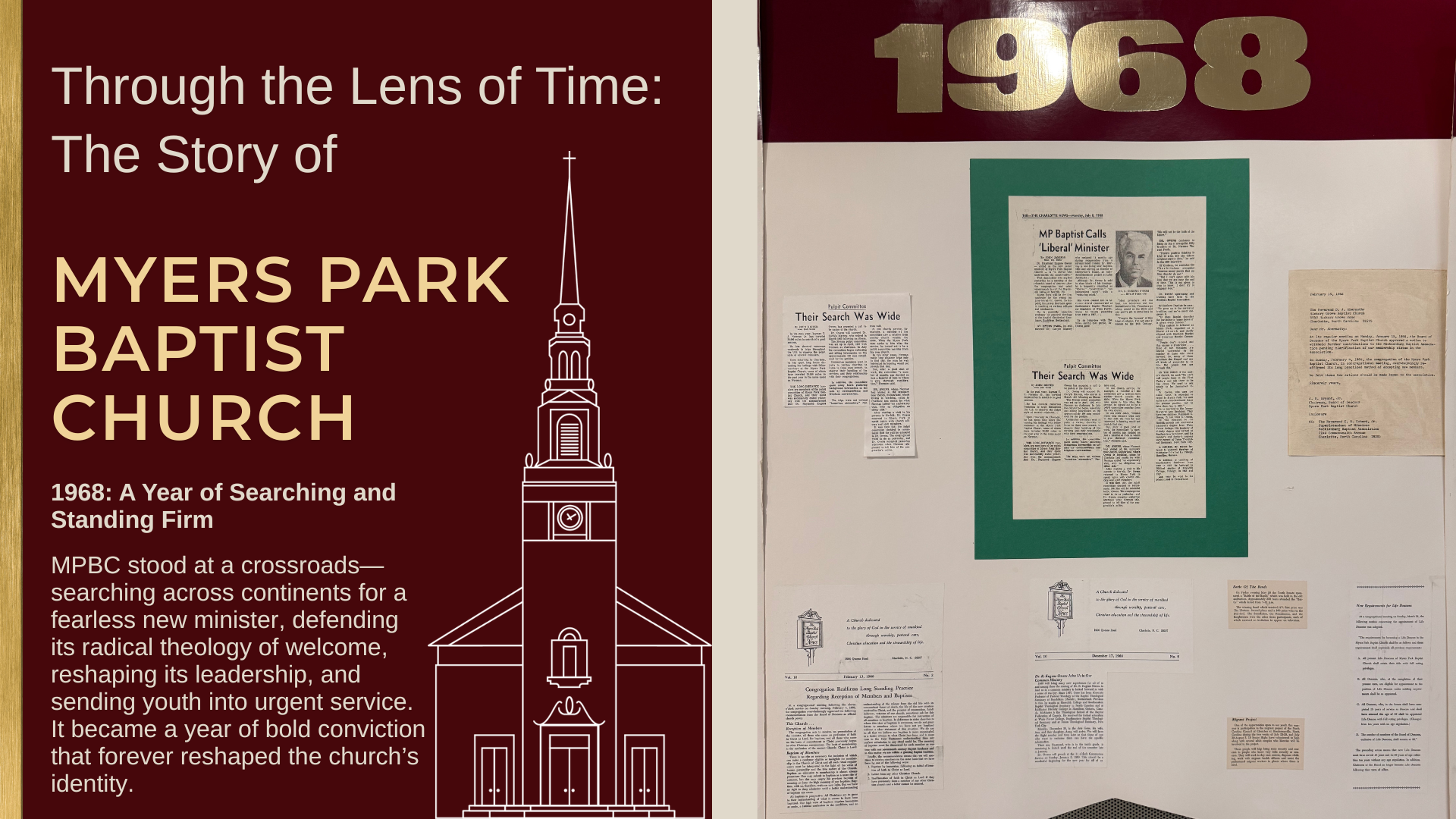
1968: A Year of Searching and Standing Firm
The story of 1968 at Myers Park Baptist Church begins at a crossroads—a moment when both the nation and the congregation were searching for direction with courage and conviction. As the country grappled with social unrest and sweeping change, the church entered its own season of transformation, guided by a deep commitment to freedom, openness, and thoughtful theological inquiry. What began as a demanding search for a minister who could match the church’s bold spirit soon became a defining journey, one that stretched across months and miles and ultimately ushered in a leader whose progressive vision and steady presence would help shape the next chapter of the church’s unfolding story.
A New Senior Minister Comes to Myers Park Baptist Church
The headline news of 1968 was the long‑awaited conclusion of the church’s search for a new senior minister. The Charlotte News announced the decision with unmistakable clarity: “MP Baptist Calls ‘Liberal’ Minister.” Another headline underscored the full scope of the effort: “Their Search Was Wide.”
The 30‑member Pulpit Committee had indeed cast a wide net—spending long nights and countless weekends reviewing information on nearly 100 candidates. Committee members traveled significant distances to hear sermons, observe pastoral leadership in context, and understand how each minister related to their congregation. Chair T. J. Norman, Jr. was said to have logged 30,000 miles “in search of a good sermon.”
Their exhaustive work culminated in early July with the announcement that Dr. Raymond Eugene Owens had accepted the call to become pastor of Myers Park Baptist Church. The Charlotte News introduced him succinctly with a statement from the Board of Deacons: Dr. Owen's is “a liberal who understands the conservative.”
This appointment marked Dr. Owens’s first pastorate. A native of Norfolk, Virginia, Owens held degrees from Wake Forest College, Southeastern Seminary, and both master’s and doctoral degrees from Union Theological Seminary in New York City. At the time of his call, he was serving as Associate Professor of Pastoral Theology at the Baptist Theological Seminary in Rüschlikon (Zurich), Switzerland. He had also taught at Meredith College, Southeastern Baptist Theological Seminary, and McMaster Divinity College of the Baptist Federation in Hamilton, Ontario.
Though Owens resisted theological labels, he was often described as liberal, progressive, an independent spirit, and a scholar with a venturing mind. His views had been considered controversial during his tenure teaching preaching at Southeastern Baptist Theological Seminary from 1960–1967.
Dr. Owens—known as Gene—planned to arrive on December 30 with his wife, Ann, and their daughter, Anna. Their son, Raymond, remained in Zurich to complete his school term and joined them in January 1969. Dr. Owens was scheduled to preach his first sermon at the 11:00 a.m. Communion Service on Sunday, January 5, 1969.
Standing Firm on Membership and Baptism Policy
In early 1968, Myers Park Baptist Church publicly reaffirmed two longstanding convictions:
- That new members should be welcomed unconditionally, and
- That baptism is a personal and thoughtful decision, never a requirement for entrance into Christian community.
Following the 11:00 a.m. service, the congregation overwhelmingly approved a recommendation from the Board of Deacons to formalize these principles as official church policy.
Reception of Members
Membership would continue to be extended to all who came:
- by baptism following a profession of faith,
- by transfer of letter from another Christian church, or
- by reaffirmation of faith when a letter could not be secured.
The basis of membership, the statement affirmed, was the ancient confession: “Christ is Lord.”
Baptism of Members
The approved policy also articulated the church’s distinctive Baptist heritage:
- No rite or ceremony determines eligibility for membership.
- Baptism “waits on new light” and should never be reduced to a mere rite of entrance.
- The church emphasizes immersion, thoughtful preparation, and deep personal meaning.
- Ministers bear responsibility for instructing all members on the significance of baptism.
In deference to partner churches with different interpretations, Myers Park Baptist would grant letters of membership only with clear explanation of its baptismal practices.
Following the vote, J. R. Bryant, Jr., Chairman of the Board of Deacons, wrote to The Rev. D. J. Abernathy of Hickory Grove Baptist Church and The Rev. E. R. Echerd, Jr., Superintendent of Missions for the Mecklenburg Baptist Association. The letter notified them that the church would withhold contributions to the Association pending clarification of its membership status in light of the reaffirmed policy.
Clarifying the Role of Life Deacons
In 1968, the church also updated its guidelines for recognizing Life Deacons.
Key changes included:
- All current Life Deacons would retain their title and full voting privileges.
- Deacons completing their current terms remained eligible for appointment.
- Going forward, 15 years of service and a minimum age of 55 were required for appointment (updated from 10 years with no age requirement).
- Chairs of the Board would no longer automatically become Life Deacons after their term.
- The Board of Deacons, excluding Life Deacons, would remain at 36 members.
Youth Serve in the Migrant Ministry Project
That summer, Senior High students participated in a two‑week service opportunity with the North Carolina Council of Churches’ Migrant Project in Hendersonville. These young volunteers brought compassion and stability to families who experienced little of either. They assisted in day care centers, distributed clothing, supported health officials, and worked alongside professional migrant service providers—building relationships and offering help wherever it was needed.
In every corner of church life—from searching for a minister who embodied intellectual courage, to articulating a theology of welcome, to shaping leadership structures and serving vulnerable communities—1968 revealed a congregation both rooted and bold. Myers Park Baptist Church stood without hesitation in its commitments, even when doing so required clarity, patience, and resolve. As the new year dawned and Dr. Gene Owens stepped into the pulpit, the church entered a fresh chapter already grounded in the values that had shaped it from the beginning: freedom, conscience, community, and the ever‑renewing call to follow Christ into deeper understanding and faithful action.