
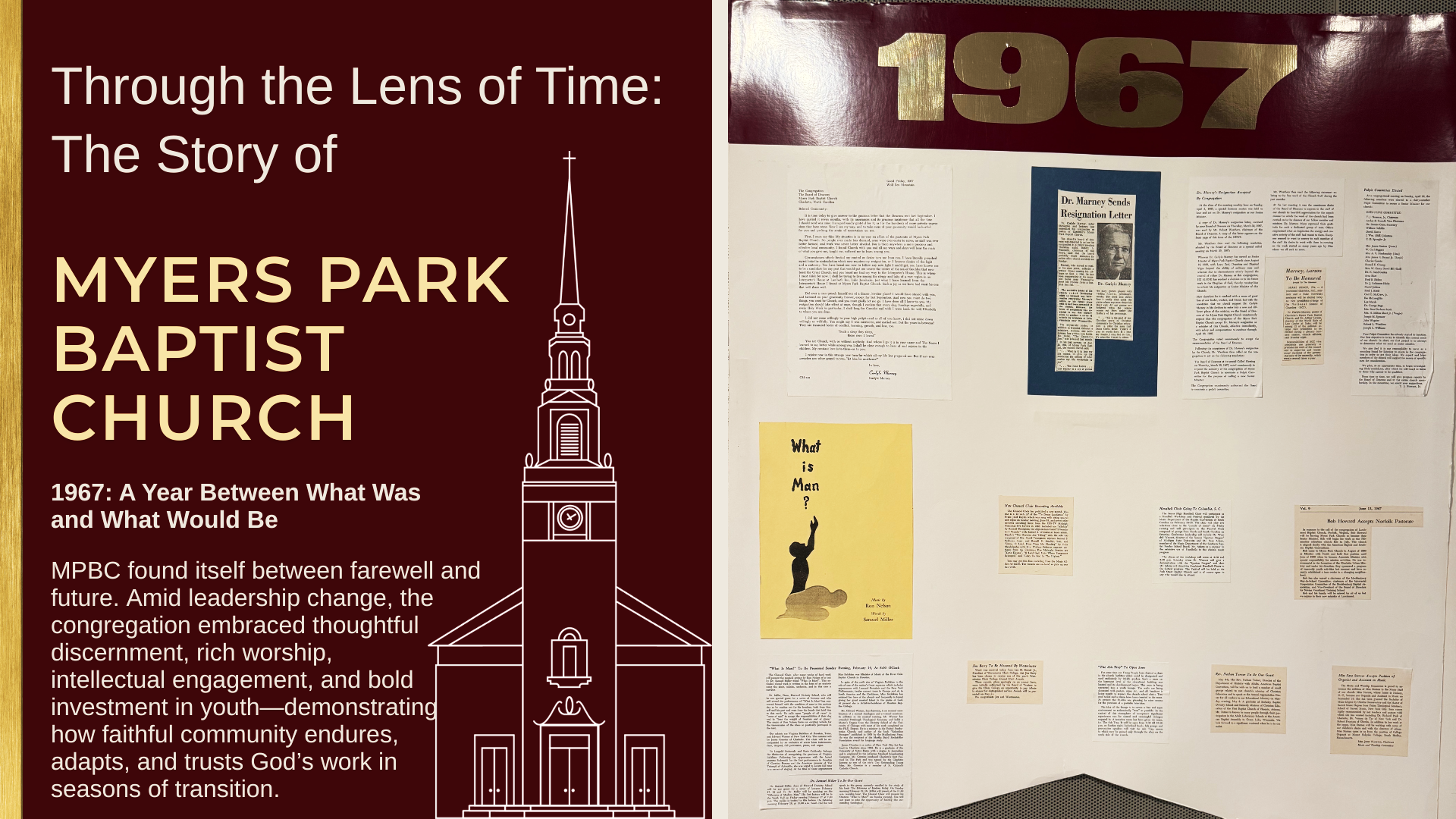
1967: A Year Between What Was and What Would Be
Some years mark themselves not by a single defining moment, but by the way a community responds to change. For Myers Park Baptist Church, 1967 was such a year—a season shaped by deep loss, courageous leadership, creative vitality, and a steady commitment to listening for God’s call amid transition. It was a year when the congregation said goodbye to a beloved minister, welcomed influential voices, celebrated faithful service, and continued to invest boldly in worship, music, and youth.
The Resignation of a Beloved Minister
The most significant news of 1967 was the resignation of Dr. Carlyle Marney, beloved Senior Minister, theologian, and lecturer after a serious illness. In a letter to the congregation, Dr. Marney wrote with both tenderness and clarity:
Circumstances utterly beyond my control or desire turn me from you. My situation is in no way an effect of the pastorate of Myers Park Baptist Church. No people ever made less demand, none were ever easier to serve, no staff was ever better formed, and work was never better divided. Nor is there anywhere a more precious and effective local community.
On April 2, Robert L. Weathers, chairman of the Board of Deacons, led a special business session at the conclusion of morning worship. During that meeting, Dr. Marney’s resignation letter was read, along with a resolution adopted by the Board of Deacons at a specially called meeting just days earlier. The resolution stated, in part:
"Whereas Dr. Carlyle Marney has served as Senior Minister of Myers Park Baptist Church since August 15, 1958, with love, zeal, devotion, and physical vigor beyond the ability of ordinary men; and whereas due to circumstances utterly beyond the control of either Dr. Marney or this congregation, he alone has reached a decision as to his future work in the Kingdom of God…
"Now therefore be it resolved, with a sense of great loss of our leader, teacher, and friend, but with the conviction that we should support Dr. Carlyle Marney in his decision to enter into a new and different phase of the ministry, we, the Board of Deacons of Myers Park Baptist Church, accept Dr. Marney’s resignation as minister of this church, effective immediately."
The news spread quickly throughout Charlotte. An article appeared in The Observer even before the special congregational session, noting that the church’s executive board had initially chosen to withhold information until it could be shared with the congregation. The article reported that Dr. Marney was expected to conduct a series of schools for ministers at Lake Junaluska near Waynesville.
The article also referenced Dr. Marney’s most recent book, The Carpenter’s Son, released the previous month, and quoted from his final sermon preached on August 23, 1956, in which he reflected:
What is to lose my life except to give up for correction the notions of what makes my life worthwhile to me? … The Book knows that society is a set of games we play, games played with various faces, personages, masks… All our games are bothered when the person comes out from under the feathers of his personage. This is the goal of our Christian years of Christian community in Christian education: to untie the man that Jesus Christ freed. There’s a play on words here. If I lose my images, I may find my life. It’s what the Gospel is about.
Seeking the Next Chapter: The Pulpit Committee at Work
In the wake of Dr. Marney’s resignation, the Board of Deacons moved swiftly to guide the church forward. A thirty‑member Pulpit Committee was elected and began its work with intentionality and care. The committee’s first task was to discern the current needs of the church and the qualities required in its next Senior Minister.
The committee expressed a strong sense of responsibility to listen broadly, stating that it sought to “serve as a sounding board by listening to others in the congregation in order to get their ideas,” and encouraged members to suggest names for consideration.
The Pulpit Committee included: T. J. Norman, Jr., Chairman; Archie B. Carroll, Vice Chairman; Dr. Bonnie Cone, Secretary; William Gribble; David Harris; J. Wm. (Bill) Johnston; C. D. Spangler, Jr.; Mrs. James Benton (Jeane); W. Carl Biggers; Mrs. A. V. Blankenship (Bea); Mrs. James R. Bryant, Jr. (Sarah); Charles Couric; Russell E. Crump; Mrs. W. Carey Dowd III (Gail); Dr. E. Reed Gaskin; Arno Hart; Fred B. Helms; Dr. J. Robinson Hicks; David Judson; Emil J. Kratt; Carl C. McCraw, Jr.; Ike McLaughlin; Lex Marsh; Dr. George Page; Mrs. Bess Durham Scott; Mrs. H. Milton Short, Jr. (Veegie); Joseph M. Spencer; John Wagster; Robert L. Weathers; and Joseph L. Williams.
As part of the search process, committee members traveled to hear likely candidates preach, continuing the congregation’s long tradition of thoughtful and prayerful discernment.
“What Is Man?”: Faith, Freedom, and the Modern World
In mid‑February, Myers Park Baptist Church welcomed Dr. Samuel Miller, Dean of Harvard Divinity School, to lead a series of lectures on “The Dilemma of Modern Man.” His visit was marked by both intellectual depth and artistic collaboration.
In preparation, the Chancel Choir devoted several weeks to rehearsing “What Is Man?”, a substantial choral work with text by Dr. Miller and music by Ron Nelson. Presented during morning worship, the piece was written in the form of an oratorio and included choir, soloists, orchestra, and a narrator.
Dr. Miller addressed the condition of modern humanity, calling people to reach for freedom—not only from the past, but from the limitations they placed upon themselves. He urged “people of all races” to “come of age,” to accept the responsibilities of their time, and to “bear the weight of freedom and of grace.”
Honors and Callings Beyond the Church Walls
Recognition and celebration also marked the year. A newspaper article from Miami Beach, Florida, announced that “a prominent Charlotte, N.C., minister and a Duke University professor” were among those elected as vice presidents‑at‑large of the National Council of Churches (NCC). Dr. Carlyle Marney, pastor of Myers Park Baptist Church, and Dr. Arthur Larson, director of the World Rule of Law Center at Duke University, were among twelve national at‑large vice presidents tasked with promoting the council’s work and supervising the governing body of the assembly.
The church also celebrated James (Jim) Berry, Minister of Music, who received a Westminster Choir College Alumni Merit Award—an honor given sparingly to recognize distinguished service.
Another significant farewell was the celebration of Bob Howard, who accepted a call to a pastorate in Norfolk, Virginia. Bob had served as Minister of Youth from 1960 to 1966 and later as Associate Minister with special responsibility for mission activities. He played a key role in the formation of the Charlotte Urban Ministry, helped sponsor a summer program for inner‑city youth, and supported the establishment of a teen center in a changing neighborhood. His leadership extended beyond the church as chairman of the Mecklenburg Stay‑In‑School Committee, chairman of the Interracial Cooperation Committee of the Mecklenburg Baptist Association, and vice‑president of the Board of Directors for Nevin Vocational Training School.
The Pulse of Music at Myers Park Baptist Church
Music continued to thrive in 1967. The Chancel Choir released a new 12‑inch LP, available through the Music Office for $3.50. The recording included Haydn’s “Te Deum Laudamus,” sung during morning worship on June 18, with string quartet and organ, along with seven additional anthems.
Selections included “Alleluia” by Randall Thompson; the Appalachian carol “I Wonder As I Wander” with Samuel S. Williams, tenor; “The Heavens Are Telling” by Haydn featuring Mrs. David Tousignant, soprano; Samuel S. Williams, tenor; and Russell D. Smalley, bass; and “Come, O Lord, Hear Thou My Pleading” by Felix Mendelssohn with Mrs. Wallace Osborne, soprano. Christmas Eve selections from the previous year included “Kyrie Eleison,” “O Lord God, Unto Whom Vengeance Belongeth,” and “Glory to God in the Highest.”
The Senior High Handbell Choir also gained recognition, participating in a Handbell Workshop and Festival sponsored by the Music Department of the Baptist Convention of South Carolina. They performed independently and as part of a Festival Choir composed of groups from North and South Carolina, alongside the renowned Spartan Ringers of Michigan State University.
Adding to the vitality of the music ministry, Miss Sara Starnes accepted the position of organist and Assistant in Music. A graduate of Oberlin Conservatory and Union Theological Seminary’s School of Sacred Music, she brought both skill and dedication, assisting with children’s choirs and supporting the directors of other ensembles.
The Ash Tray: Making Space for Teen Voices
Responding to the needs and creativity of its youth, Myers Park Baptist Church designated a basement‑level room in the education building as a space exclusively for students in grades 9–12. The room was transformed into a youth lounge, furnished with donated furniture, pool tables, a stereo, and walls covered with posters and signs. Students even planned a fundraiser to purchase a portable television.
The vision for the space was “to create a free and open environment as authentically ‘teen’ as possible,” fostering acceptance, meaningful experiences, and honest dialogue. The room was tentatively named “The Ash Tray,” open Sunday evenings from 6:30 to 10:00 p.m., accessible through the alley on the south side of the church. Bands, folk groups, and provocative speakers were welcomed—an early sign of the church’s willingness to trust and empower its young people.
Holding Fast While Moving Forward
Looking back, 1967 stands as a year of profound transition and faithful continuity at Myers Park Baptist Church. Amid the loss of a beloved minister, the congregation demonstrated resilience, thoughtful leadership, and an unwavering commitment to worship, education, music, and youth. Even in moments of uncertainty, the church listened deeply, honored its past, and invested boldly in its future—trusting that God’s work continued, not despite change, but often through it.