
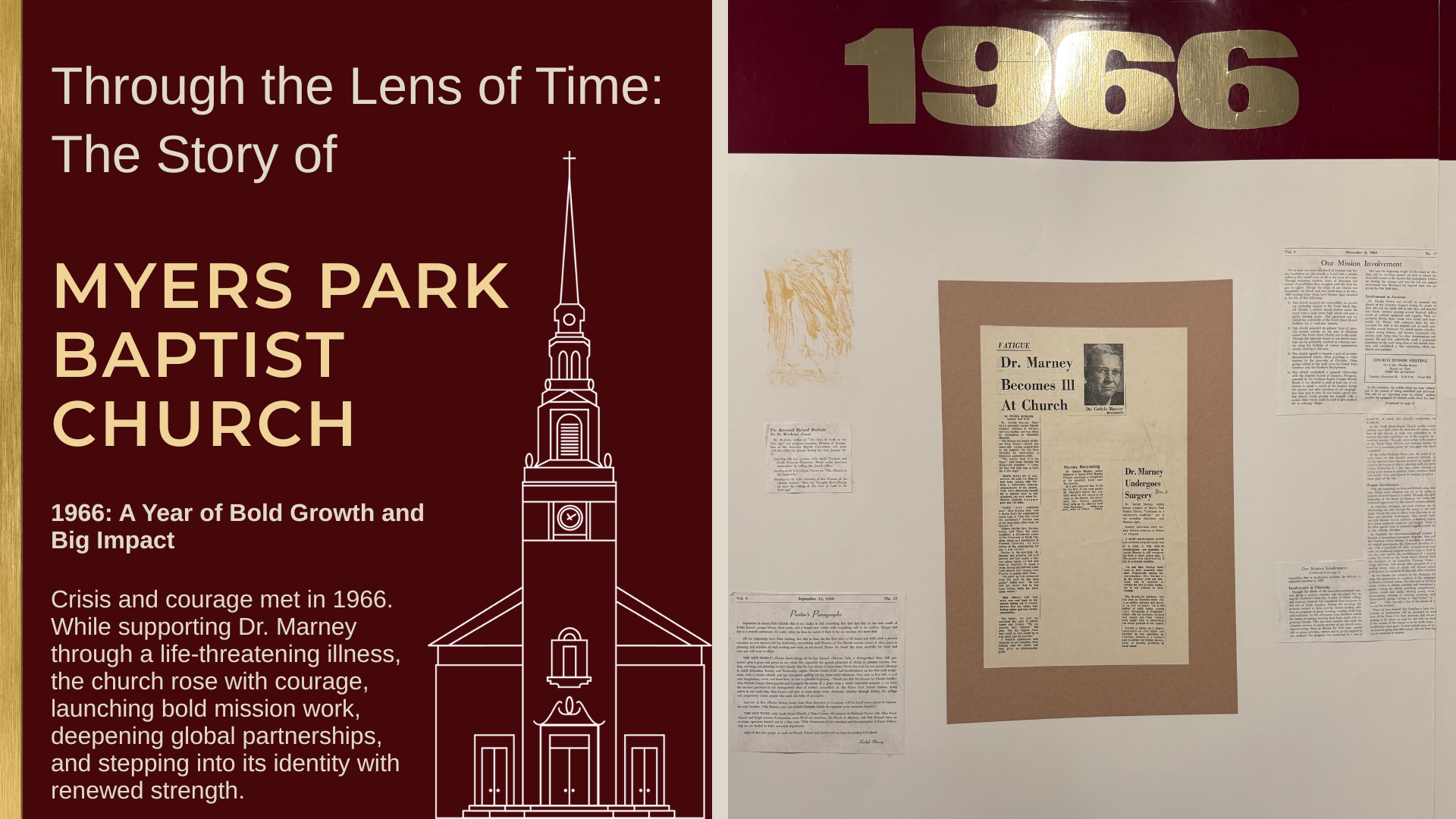
1966: A Year of Bold Growth and Big Impact
As we step into 1966 in the unfolding story of Myers Park Baptist Church, we enter a year full of energy, growth, and heartfelt concern. It was a year in which the congregation experienced both the vulnerability of its beloved pastor and the incredible momentum of a church alive with purpose which extended beyond the church walls and even far beyond Charlotte.
"All of our beginnings have been exciting, but this is the best.”
One pastoral reflection from early in the year captured the spirit of 1966 with striking clarity:
All of our beginnings have been exciting, but this is the best: for the first time, a full house and staff; such a smooth transition to new deacon and lay leadership; stewardship and Women of the Church months ahead of other years in planning; full schedule of vital teaching and work on the board.
This sense of enthusiasm was palpable across the church. With newly organized lay leadership, advanced planning, and a rich calendar of teaching and community life, MPBC entered 1966 with a remarkable feeling of readiness and renewal.
A Dynamic New Staff Team
A significant part of this renewed energy came from the arrival of three deeply gifted leaders who quickly wove themselves into the fabric of church life.
Charles Davis
With formative training at Mercer, Yale, and a distinguished pastorate at Mars Hill, Charles Davis brought a rare blend of intellectual depth, pastoral sensitivity, and teaching excellence. His contributions were immediately felt, particularly in adult education, and many commented that in worship, pastoral relations, planning, and conversation, it seemed as if he had “always had a home here.”
Charles Smith
Educated at USC and Southeastern, Charles Smith brought “imagination, verve, and know‑how” to his ministry with children and youth. His programs were so lively that “youngsters were spilling out his doors every afternoon,” filling the church hallways with energy, laughter, and curiosity.
Miss Frances Gunter
A respected dean of student counselors in the Myers Park School System, Miss Frances Gunter continued to offer her wisdom to MPBC by spending weekday afternoons with college and preparatory school students who needed expert guidance. Her steady presence provided support during a time when many young people were facing significant personal and societal transitions.
Together, these leaders helped the church grow in depth, creativity, and responsiveness to the needs of its congregation.
A Community Rallies Around Its Pastor
Amid all this momentum, the church was confronted with a moment of deep concern. Newspaper clippings from 1966 document how Dr. Carlyle Marney became seriously ill while at church and later underwent surgery. His sudden illness sent shockwaves through the congregation and the city.
For years, Marney had shaped MPBC’s identity with preaching that was challenging and courageous, pastoral leadership that was both compassionate and incisive, and a theology that invited people to think expansively about faith. In his moment of vulnerability, the church responded with prayer, unity, and a profound sense of care.
National Recognition in a Difficult Year
Even as he faced illness, Dr. Marney’s leadership and insight were recognized nationally.
In 1966, President Lyndon B. Johnson appointed him to a federal commission tasked with advising the government on poverty in rural America. His work on the commission reflected his long‑standing commitment to justice, equity, and the dignity of every person—a commitment mirrored in the life and mission of MPBC.
Mission and Outreach in Full Motion
The church’s sense of purpose extended well beyond its own membership in 1966. MPBC took significant steps in local outreach, formed new partnerships, and deepened its global connections.
Inner‑City Charlotte: Summer Ministry and Partnerships
Through the efforts of an interdenominational mission group, a ten‑week summer ministry was developed in an area of Charlotte’s inner city. A team of 15 college and seminary students served each morning at three activity centers, leading children in group learning, worship, field trips, and recreation. In the afternoons, team members visited homes, listening carefully, learning basic needs, and expressing genuine pastoral concern.
Nearly 70 MPBC volunteers—adults and youth—supported the ministry as drivers for field trips, special aides in group activities, home visitors, and practical supporters of the student team. MPBC also donated funds to sustain the program.
At Tenth Street Baptist Church, weekly worship services were held under the direction of various MPBC members. Through conversations with congregants and nearby residents, MPBC helped discern the need for a recreation center for teenagers.
In the wider Piedmont Courts area, the church’s primary focus was inner‑city ministry. MPBC members engaged in regular visitation with elderly neighbors, led craft and sewing classes, provided leadership in a day care center, and offered tutoring and piano lessons to children. Other MPBC members—both adults and youth—joined additional tutoring programs across the city, extending the church’s educational ministry beyond a single neighborhood.
Global Partnership: Asunción, Paraguay
The year also saw an important strengthening of MPBC’s relationship with the hospital at Asunción, Paraguay, operated by the Southern Baptist Foreign Mission Board. Beyond sending Dr. Charles Brown to provide medical care—work in which his wife Lois also participated—MPBC established a personal, ongoing partnership with the hospital and its surrounding communities.
One of the most ambitious commitments of 1966 was the decision for MPBC to provide a mobile clinic—an “operating room on wheels”—to extend medical care to outlying villages. The clinic was ordered and in assembly, with delivery expected sometime in 1967. As part of this growing partnership, the congregation was invited to consider direct personal involvement, with particular needs for additional physicians, an architect, a building engineer, and a home economist to support training, infrastructure, and community health.
A Year of Strengthened Identity
In every dimension—pastoral leadership, staff vitality, mission commitment, congregational energy, and global engagement—1966 stands as a defining year for Myers Park Baptist Church. The community’s resilience became visible through its care for Dr. Marney and its pride in his national service, while a fully engaged staff expanded the church’s capacity for worship, education, counseling, and youth ministry. At the same time, mission took compelling shape both locally—through an inner‑city summer ministry, partnerships with Tenth Street Baptist Church and work in Piedmont Courts—and globally, through an enduring relationship with Asunción and the bold promise of a mobile clinic to reach villages beyond the city. Together these efforts revealed a congregation moving with unity and purpose, rooted in compassion, courageous in service, and eager to live its faith in meaningful and transformative ways.