
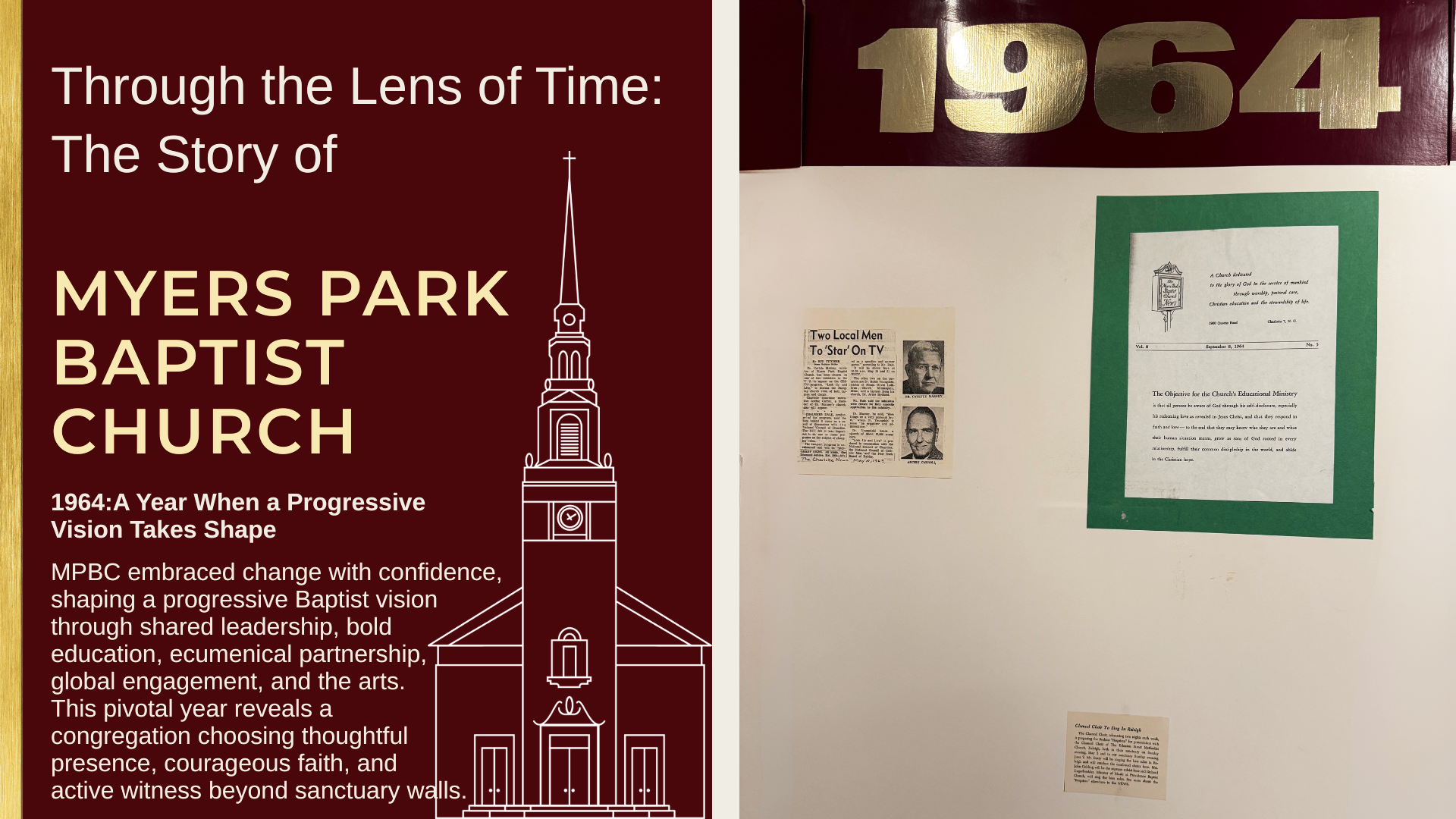
1964 - A Year When a Progressive Baptist Vision Takes Shape
In 1964, Myers Park Baptist Church was not content to simply keep pace with change—it helped lead it. At a time when the role of the church was being redefined by social upheaval, ecumenical dialogue, and evolving understandings of leadership, the congregation embraced a progressive Baptist vision rooted in education, collaboration, and engagement with the world God so loves. This spirit of openness and engagement was vividly on display when the congregation found itself participating in a national conversation about the future of the church.
A National Voice for a Shared Ministry
Our congregation stood at the forefront of a changing church, modeling a progressive Baptist vision that embraced dialogue, education, and engagement beyond sanctuary walls. This forward-looking spirit was captured when Dr. Carlyle Marney, Senior Minister of Myers Park Baptist Church, was selected as one of only two U.S. ministers to appear on the national CBS television program “Look Up and Live.”
Joining him was Archie Carroll, a lay leader from the congregation and a Charlotte insurance executive. Together, they represented the shared ministry of clergy and laity, discussing how the roles of both were evolving in a rapidly changing society. Produced in cooperation with the National Council of Churches, Catholic leaders, and Jewish rabbis, the two-part program reflected on a deep ecumenical commitment to conversation across religious traditions.
Dr. Marney was noted for his deeply personal approach to ministry, offering a compelling contrast to more administrative models of church leadership and underscoring the importance of authenticity, relationship, and theological reflection in pastoral life.
Education as Formation for Faithful Living
At the same time, the church articulated a bold educational mission: to help all people become aware of God’s self-disclosure and redeeming love in Jesus Christ; to grow in faith and relationship; to live out shared discipleship in the world; and to remain grounded in Christian hope.
Education at Myers Park Baptist Church was understood not as information alone, but as formation—shaping lives for meaningful, faithful living. Learning was viewed as an essential expression of discipleship, equipping individuals to engage both church and world with wisdom and purpose.
Sharing a Vision Beyond Borders
This commitment to educations and communication extended globally. Mr. Bob McClernon received unanimous approval from the Board of Deacons to serve as a faculty member for Air Force Chaplain seminars in England and Germany. Teaching on the theme “Communicating the Gospel,” his work focused on theological frameworks for communication and adult education.
The invitation—extended at no cost to the church—signaled national recognition of Myers Park Baptist Church's innovative approach to ministry and its willingness to contribute thoughtfully to the broader life of the church beyond local and national boundaries.
Music, Collaboration, and Ecumenical Partnership
The life of the church in 1964 also flourished through music and the arts. The Chancel Choir, rehearsing diligently, prepared Brahms’ Requiem for joint performances with Edenton Street Methodist Church in Raleigh and later in the Myes Park Baptist Church sanctuary.
In Raleigh, Jim Berry sang the bass solos later returning to conduct the combined choirs at Myers Park Baptist Church. Mrs. John Golding served as soprano soloist, and Richard Ungerbuehler, Minister of Music at Providence Baptist, sang the bass solos. These collaborations reflected both musical excellence and a deepening commitment to ecumenical collaboration.
A Faith Taking Shape in the World
Together, these moments tell a larger story of a congregation seeking to live faithfully at the intersection of tradition and change. In 1964, Myers Park Baptist Church embodied a progressive Baptist witness marked by shared leadership, ecumenical openness, global awareness, lifelong learning, and artistic expression. Through these commitments, the church bore witness to a faith that was not confined to sanctuary walls but actively engaged the world as an expression of following Christ with courage, imagination, and hope.