
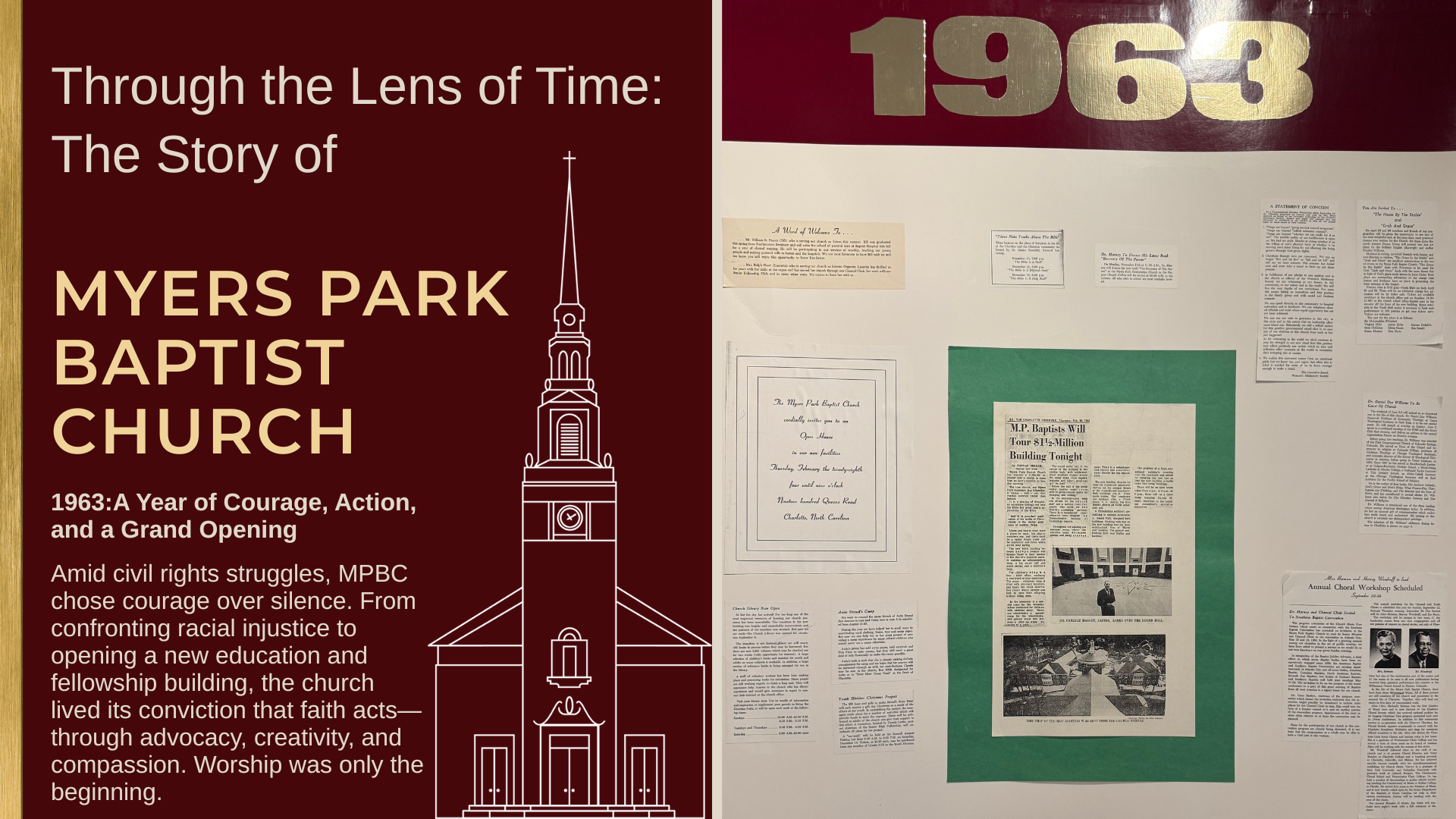
1963: A Year of Courage, Action, and a Grand Opening
In the mid-20th century, Myers Park Baptist Church stood at a crossroads where faith met the urgent demands of history. In an era marked by civil rights struggles and cultural change, the congregation refused to retreat into silence or sentimentality. Instead, it embraced a bold vision: that Christian love must be lived publicly, with conscience and courage. From prophetic statements against racial injustice to building spaces for learning and community, the church sought to embody a faith that acts—speaking truth, fostering inclusion, and shaping hope for a more just world. This is the story of a church that believed worship was only the beginning.
Conscience and Moral Courage
In a time when silence was easy and justice costly, the Women’s Missionary Society raised its voice with a Statement of Concern that shook complacency and called the congregation to courageous action to confront racial injustice and moral indifference. Speaking with honesty and urgency, the statement affirmed that Christian love requires action, courage, and public witness. It named racism as a spiritual crisis and urged advocacy, voting, and community engagement so that faith might move beyond silent prayer into faithful action. Even while acknowledging emotion, the statement testified to hope - that moral clarity and courage could still shape a more just future.
A Church Built for Community and Action
As reported by The Charlotte Observer, when Myers Park Baptist dedicated its new educational and fellowship building, it declared in brick and mortar that faith is not confined to Sunday worship but thrives in spaces where learning and compassion meet. Designed as a place where minds and hearts meet, the building embodied a hopeful vision of faith lived out through study, care, and action. With spaces for children, youth, counseling, music, and accessibility for children with disabilities, the church affirmed that Christian faith must respond practically and compassionately to the needs of people. The open house celebrated not simply a structure, but a conviction: the church exists to reach outward, nurturing community and engaging the challenges of modern life.
Faith Through Drama and Imagination
In the spring, with two one-act plays by Charles Williams—The House by the Stable and Grab and Grace, —the newly formed Drama Group proved that humor and imagination are not distractions from faith, they are its living language. Through story and symbol, the church explored human need and God’s grace, welcoming the wider community into thoughtful and creative engagement with the gospel. The cast included Ike McLaughlin (Director), Virginia Mills, Osee Childress, Susan Marney, Janice Kirby, Glenn Eason, Don Davis, Garven Dalglish, and Ben Benoit.
Theological Depth for a Living Faith
The visit of Dr. Daniel Day Williams, one of the leading theologians of the time, marked a significant moment of intellectual and spiritual enrichment. Through preaching and teaching, Dr. Williams helped the congregation think deeply about grace, hope, and the care of souls as well as reminding them that a living faith must also act boldly. His presence reflected Myers Park’s commitment to a faith that is both theologically serious and accessible, grounded in scholarship yet responsive to everyday life.
Celebrating Dedicated Service
During the summer months, the church welcomed William (Bill) R. Pearce as a pastoral intern, strengthening its ministry of teaching, worship, and pastoral care. The church also celebrated Lauretta Short as Interim Organist, honoring her long-standing musical leadership and faithful service. These moments reflected continuity, gratitude, and investment in future leadership.
Justice, Compassion, and Shared Responsibility
By supporting Anita Stroud’s Story Hour Camp, Myers Park Baptist turned conviction into action, affirming the church’s growing commitment to racial justice and equity. By contributing resources and financial support, Myers Park Baptist helped make possible a camp experience for Black children who would otherwise be excluded. This ministry reflected a hopeful belief that faith must be expressed through concrete acts of solidarity and generosity.
Music as Shared Ministry
The annual Chancel and Youth Choir Workshop became more than a rehearsal; it was a sign of the power of music to unite generations in worship. The workshop brought together past and present music leaders of the church (Alice Berman, Harvey Woodruff, and Jim Berry) celebrating continuity, excellence, and collaboration. With new music and gifted leadership from within the congregation, the workshop reflected a belief that worship forms faith and unites generations.
Healing and the Human Person
In November, Dr. Marney’s presentation on The Recovery of the Person highlighted the church’s ongoing focus on wholeness, care, and personal dignity. Hosted ecumenically, the event reinforced Myers Park’s openness to shared learning across denominational lines.
Youth Leading with Compassion
As the year closed, Myers Park Baptist's youth transformed generosity into joy, organizing a Christmas project to provide gifts for children in Anita Stroud’s Story Hour and thereby teaching discipleship through service and shared responsibility. Through fundraisers and shared effort, young people learned that discipleship includes generosity, responsibility, and joy in serving others.
Conclusion: A Legacy of Living Faith
The story of Myers Park Baptist Church in this pivotal era is more than a record of programs and events—it is a testimony to what happens when faith refuses to remain passive. From prophetic calls for justice to spaces built for learning and care, from creative engagement through drama and music to deep theological reflection, the church embraced a vision of discipleship that was active, courageous, and hopeful. It understood that Christian love is not an abstraction but a lived reality—expressed in advocacy, generosity, and shared responsibility. In a world still wrestling with division and despair, this legacy speaks with enduring clarity: when conscience is awakened and moral courage takes root, the church becomes what it was always meant to be—a community where faith moves beyond words into transformative action.