
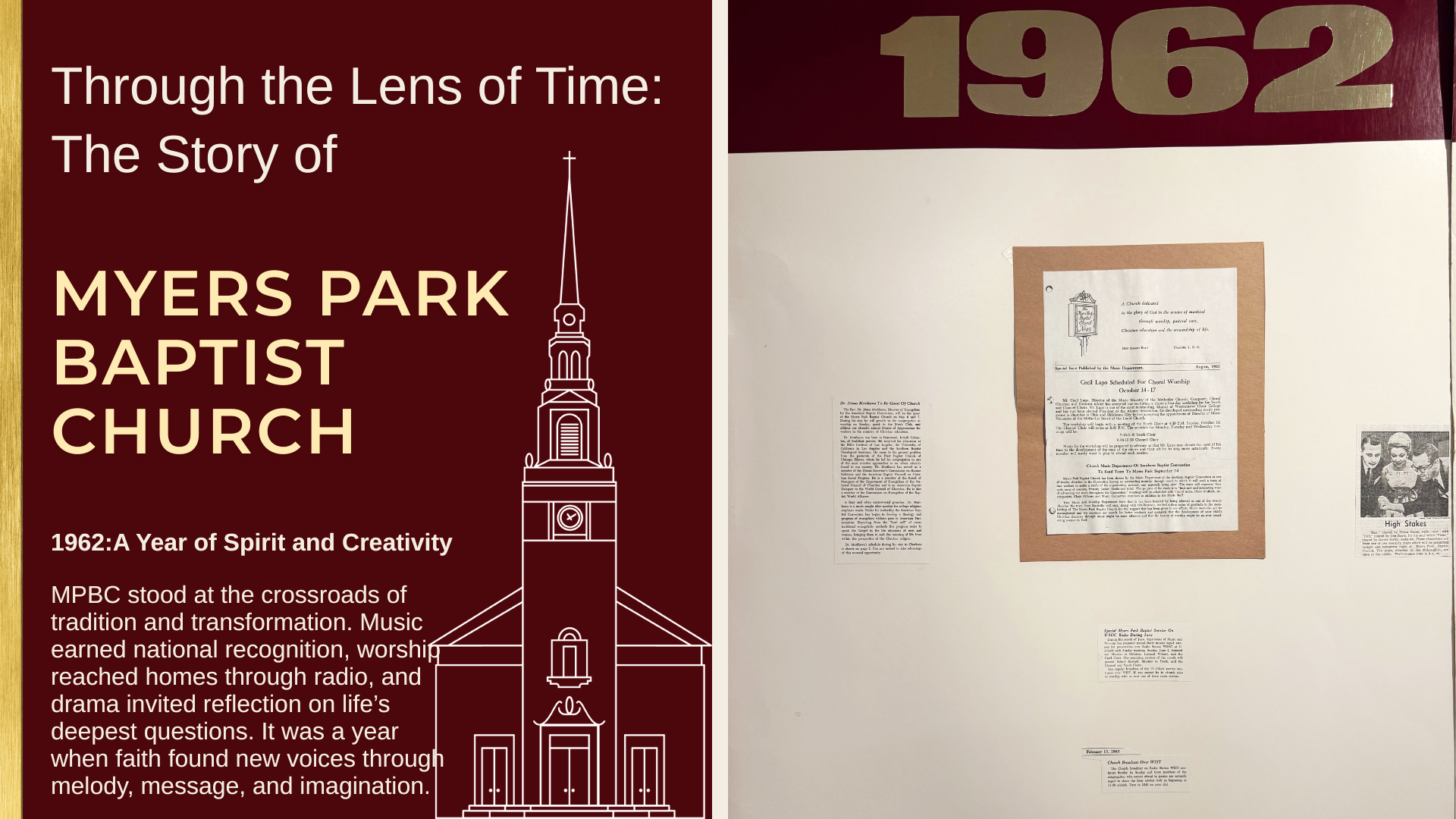
1962 - A Year of Spirit and Creativity
The year was 1962. Beyond the streets of Myers Park, a Baptist congregation stood at the crossroads of tradition and transformation. Inside its sanctuary, voices rose, not as mere performance, but as a living testimony of faith. Music became the heartbeat of a community, so compelling that it drew national attention. Worship spilled beyond brick walls, carried on radio waves into homes across the city. Even the stage became sacred ground, where morality plays wrestled with pride, temptation, and the fate of the soul. This was no ordinary year. It was a season when Myers Park Baptist dared to believe that God’s Spirit moves through melody and message, through drama and dialogue, through every creative act that speaks hope into a changing world.
Music Ministry Gains National Recognition
That year, the church’s music ministry received national recognition when the Music Department of the Southern Baptist Convention selected Myers Park Baptist as one of only twenty churches to be studied for its outstanding work. This honor affirmed what the congregation already knew: music at Myers Park Baptist was not performance, but formation—shaping Christian character across generations and opening ever-widening pathways to God. With gratitude and humility, the church committed itself anew to learning, growing, and deepening worship for children, youth, and adults alike.
A Visionary Voice: Dr. Jitsuo Morikawa
This same spirit of openness and hope was embodied in the visit of Dr. Jitsuo Morikawa, a visionary leader in evangelism and whose life and ministry crossed cultural, religious, and social boundaries. Born to Buddhist parents and shaped by both global and urban experience, Dr. Morikawa proclaimed a gospel rooted not in pressure or fear, but in meaning, relationship, and lived experience. His presence reminded the church that evangelism at its best listens deeply, honors human dignity, and speaks God's love into the real circumstances of people’s lives—especially in a complex and changing world.
Extending Worship Beyond Walls and onto the Airwaves
In 1962, the church also embraced emerging media as a form of mission. Through regular radio broadcasts and specially prepared worship services, Myers Park Baptist extended its sanctuary beyond its walls, ensuring that those unable to attend in person could still participate in worship, prayer, preaching, and music. Worship became something shared, not confined—an act of care and connection reaching into homes across the community.
Music as a Unifying Gift
Music continued to flourish at Myers Park Baptist Church as a powerful force for unity and ecumenical connection. In 1962, the church welcomed Cecil Lapo, Director of Music for the Methodist Church, composer, choral clinician, oratorio soloist, and nationally respected musician, to lead a four-day workshop. His presence underscored the congregation’s conviction that God’s Spirit moves freely across denominational lines. Through disciplined rehearsal, artistic growth, and shared commitment, choirs were formed not merely to sing well, but to worship together.
Drama as Witness
Drama found a meaningful place in the church’s witness during this season of creativity. Morality plays exploring themes of pride, temptation, and the struggle for the soul invited the wider community to reflect on life’s deepest questions. These performances affirmed that the church proclaims hope not only through words, but through story, symbol, and imagination. Under the leadership of Ike McLaughlin, the Drama Group brought these ideas to life. One memorable production, High Stakes, featured Glenn Eason as “Man,” rolling dice with Hell—played by Don Davis—for his soul, while Pride, portrayed by Janice Kirby, looked on. Through such vivid portrayals, the church offered a compelling invitation to consider the choices that shape human destiny.
Looking back on 1962, Myers Park Baptist Church emerges as a community unafraid to innovate while remaining deeply rooted in faith. Through music that shaped character, voices that reimagined evangelism, worship carried beyond walls, and creative arts that stirred reflection, the church embodied a gospel of openness and hope. These efforts were not isolated programs, they were expressions of a larger vision: that God’s Spirit moves through beauty, dialogue, and shared experience. In every note sung, every word spoken, and every story performed, Myers Park Baptist proclaimed a timeless truth: faith is alive when it listens, creates, and reaches outward in love.