
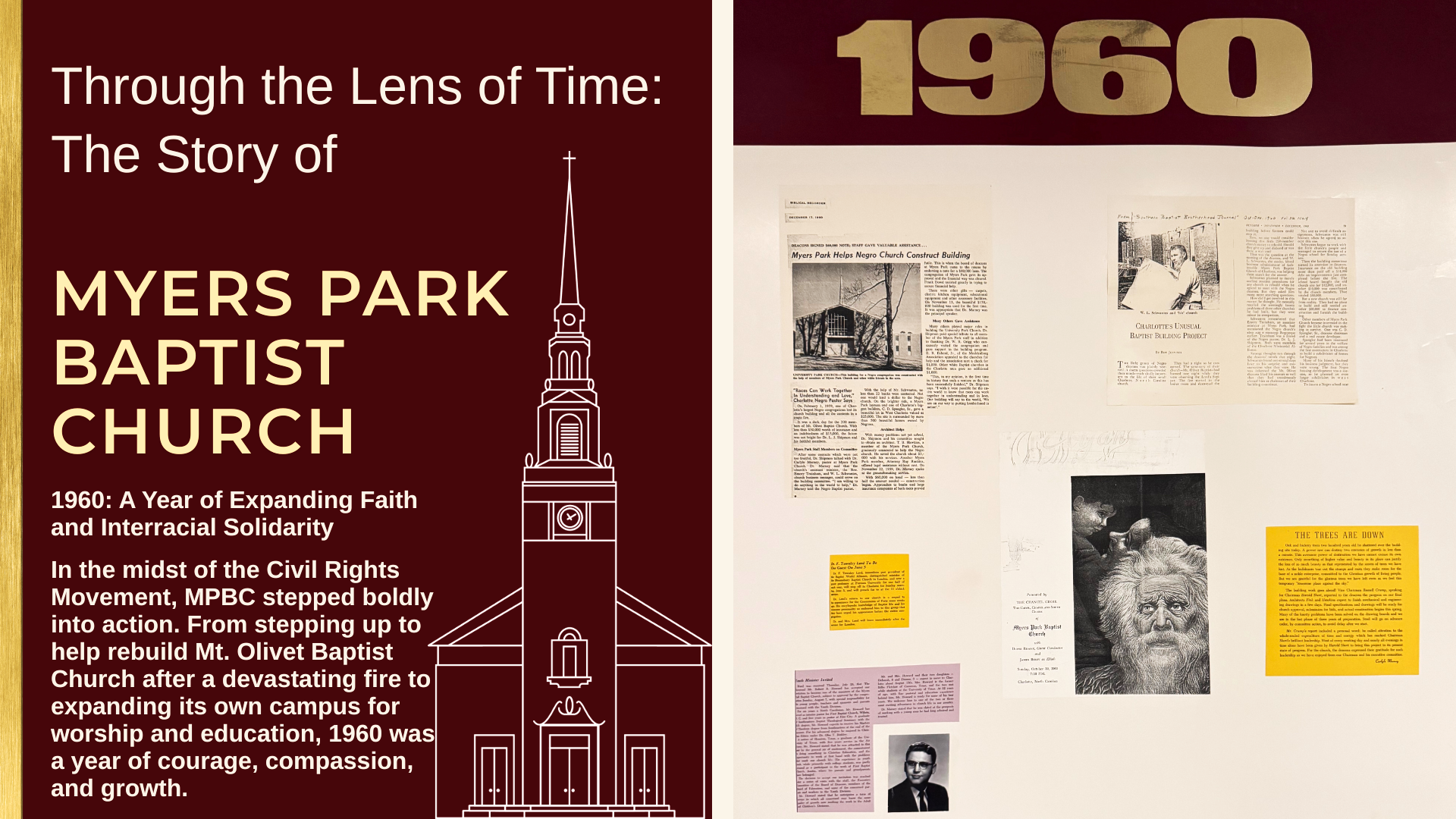
1960 - A Year of Expanding Faith and Interracial Solidarity
The year 1960 was a watershed moment in American history—a time when the Civil Rights Movement was gaining momentum and communities across the South were grappling with questions of justice, equality, and reconciliation. In Charlotte, these national currents touched Myers Park Baptist Church in profound ways. Against a backdrop of racial segregation and systemic barriers, the congregation chose a different path: one of solidarity, compassion, and bold action. From helping rebuild Mt. Olivet Baptist Church after a devastating fire to expanding its own campus for worship and education, Myers Park Baptist demonstrated that faith could be a force for change—bridging divides and shaping a more inclusive future.
Justice In Action
A defining aspect of 1960 was the church’s active role in supporting Mt. Olivet Baptist Church, a predominantly African American congregation in Charlotte that had suffered a catastrophic fire in February 1959. After Mt. Olivet's pastor Dr L. J. Shipmon's attempts to find help through community contacts were unsuccessful, he turned to Dr. Carlyle Marney. Recognizing the urgent need, Myers Park Baptist Church offered assistance. Dr. Marney declared, "I am willing to do anything in the world to help."
Rev. Emory Trainham, MPBC Assistant Minister and friend of Dr. Shipmon, and W. L. Schwantes, MPBC Business Manager, met with Mt. Olivet's deacons to share their expertise. The deacons were so impressed by their ideas that they were invited both men to serve on the building committee, and Mr. Schwantes was unanimously elected chairman. He quickly secured a temporary space at a nearby school for their Sunday services.
Generosity flowed from the Myers Park Baptist community. C. D. Spangler, Sr., a church member and prominent builder, donated a $25,000 lot for the new church building in West Charlotte. Architect T. B. Hawkins, also a member, volunteered his services, saving approximately $3,000. Attorney Ray Rankins provided legal support at no cost. Despite systemic financial obstacles (22 banks declined loans), the MPBC congregation and lay leaders stepped in decisively. The Board of Deacons endorsed a $60,000 loan, approved by the congregation, to cover construction costs, clearing financial barriers for Mt. Olivet’s rebuilding. Frank Dowd also played a key role in securing financial assistance. Beyond funding, MPBC members donated carpets, electric kitchen equipment, educational equipment, and other essential facilities.
Through these combined efforts, the new $150,000 Mt. Olivet building was completed and dedicated, under its new name, University Park Church, on November 13, 1960, with Dr. Marney being invited as the principal speaker. Dr. Shipmon described the collaboration as historic, noting that it demonstrated that races “can work together in understanding and in love. Our building will say to the world, 'We are on our way to putting brotherhood in action.'”
Building and Campus Expansion
Meanwhile, Myers Park Baptist Church continued planning its own campus improvements. Vice Chairman Russell Crump reported that architects Fink and Hawkins were finalizing mechanical and engineering drawings. The construction phase required removing two-century-old oak and hickory trees, a powerful symbolic gesture representing the transition from the old to a modernized church campus. The new facilities were designed to support worship, education, and fellowship for the growing congregation.
Youth and Education Initiatives
With the expanded facilities on the horizon, 1960 also emphasized Christian education and youth ministry. The church recruited Rev. Robert R. Howard to strengthen programs for young people and their parents, integrating him into the broader staff team. This strategic focus reflected a commitment to the long-term vitality of the congregation and the nurturing of future church leaders.
Recognition of Volunteer Leadership
Church leadership acknowledged the extraordinary dedication of volunteers and staff in supporting building and educational initiatives. Harold Short, chairman of the deacons’ executive committee, received special praise for his tireless leadership and long hours devoted to planning and preparing for the church’s expansions. Similarly, the Board of Deacons was recognized for its commitment to both the church’s internal growth and its outreach projects, including support for Mt. Olivet Baptist Church.
The year 1960 stands as a defining chapter in the history of Myers Park Baptist Church—a year marked by courageous action, deep compassion, and visionary growth. Through its unwavering commitment to interracial justice, the church helped rebuild Mt. Olivet Baptist Church, forging bonds of solidarity that transcended racial barriers and embodied the spirit of brotherhood. At the same time, Myers Park Baptist expanded its own campus and strengthened its educational and youth ministries, laying a foundation for future generations. These efforts reflect a congregation living out its faith in tangible ways—building bridges, nurturing community, and demonstrating that love in action can transform lives and shape history.