
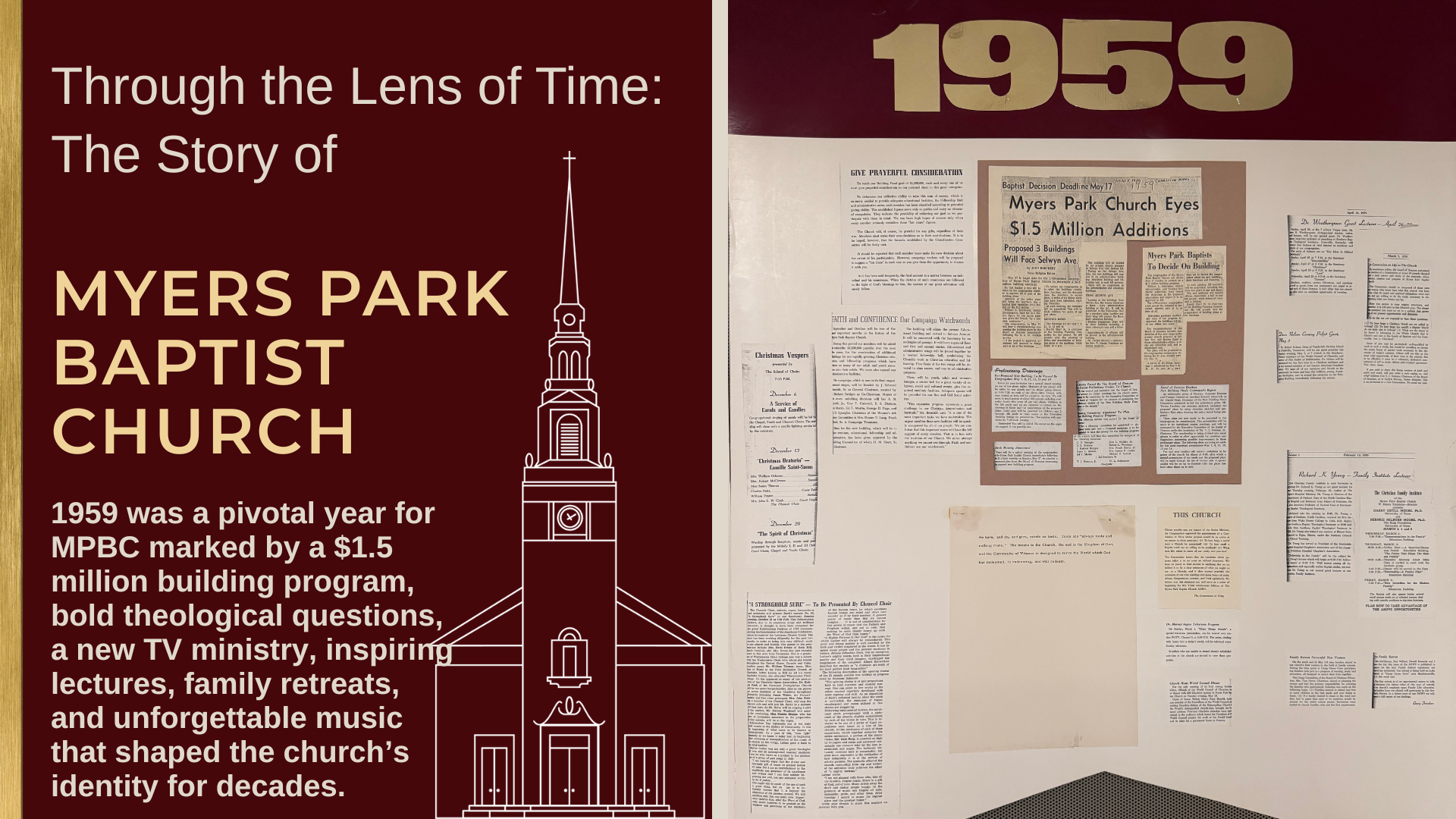
1959 - A Year of Questions of Becoming
Under the visionary leadership of Dr. Carlyle Marney, 1959 marked a turning point for Myers Park Baptist Church, a year when bold plans and deeper questions converged. It was a season of expansion, as the congregation embraced a $1.5 million building program that would transform the campus, and a season of introspection, as the Commission of Forty wrestled with what it truly means to be a Baptist church in a changing world. From architectural dreams to theological inquiry, from televised ministry to vibrant worship and music, Myers Park Baptist stood at the threshold of becoming, not just a larger church, but a more thoughtful, engaged, and faithful community.
New Era of Expansion
In 1959, Myers Park Baptist Church stood on the threshold of remarkable growth, both in spirit and in structure. That year, the congregation prepared to vote on a $1.5 million building program that would transform the campus along Selwyn Avenue. The ambitious plans included a new administration building, an education building, a fellowship hall large enough to seat 850 people, a choir rehearsal room, and a fully equipped kitchen. The campaign was headed by J. Edward Burnside, Sr. as General Chairman, assisted by Herbert Bridges as Co-Chairman, along with A. B. Carroll, Jr., Guy T. Carswell, R. S. Dickson, Ed T. Martin, Lex Marsh, George D. Page, and C. D. Spangler, Mrs. Homer V. Lang, and Frank Dowd, Sr.
To share this vision and engage the entire church family, six dinner meetings were held in May, each inviting 225 members—including children—to imagine the future together. On May 17, following worship, the congregation approved the building resolution and was called to give prayerful consideration toward reaching the Building Fund goal of $1,500,000.
Baptist Identity and Questions
Myers Park Baptist’s vision in 1959 reached beyond bricks and mortar. Under Dr. Marney’s leadership, the Commission of Forty presented a thoughtful exploration of what it means to be a Baptist church in a changing world. Charged with surveying and studying the concepts, ideas, doctrine, mission, and purpose of the church, the Commission sought to answer profound questions about identity and calling.
Dr. Marney’s invitation to serve on the Commission captured the spirit of the moment:
There was genius in your origins, structures, and operation. It is still alive in the fifteenth year. The dream that possessed you must be set to a melody that grows out of our present opportunities and demands.
The Commission’s work centered on three defining questions:
- To how large a world must a church be committed?
- To how small a Baptist world are we willing to be confined?
- What does this mean in terms of our polity and practice?
These questions reflected a spirit of inquiry and openness that would shape Myers Park Baptist’s theological character for decades to come.
Faith on the Airwaves
1959 also marked the beginning of Dr. Marney’s television ministry, “These Things Remain,” broadcast weekly on WBTV. The series addressed family life in modern society, extending the church’s pastoral reach beyond Selwyn Avenue to the broader Charlotte community.
Voices That Inspire
In April, Myers Park Baptist hosted a four-day lecture series featuring Dr. Jesse Burton Weatherspoon, long-time professor of preaching at Southern Baptist Theological Seminary. His lectures on “Key Ideas in Biblical Christianity” explored themes of Responsibility, Obedience, Love, and Purpose, and were open to the Charlotte community.
That same year, the church welcomed distinguished guests from the World Council of Churches for a dinner attended by 200 Charlotte lay leaders—the only meeting of its kind among Southern cities. Bishop Henry Knox Sherrill, retiring President-Bishop of the Episcopal Church and American member of the Praesidium, delivered the featured address, sharing the Council’s vision and plans for a permanent home in Geneva.
As part of the church's American Preachers Series, Dr. Robert Nelson, Dean of Vanderbilt Divinity School and former Secretary of the World Council of Churches, preached at Myers Park Baptist on May 3, bringing a global perspective to the pulpit.
Family Life in Focus
The church’s commitment to family ministry took shape in May with its first Family Retreat at Lake Summit, held at Camp Green Cove near Hendersonville. Nine families—each with two or more children—spent a weekend of worship, study, and recreation designed to enrich their lives together. A highlight of the retreat was a Hollywood-style evening of skits and stunts performed by the families themselves, blending laughter with fellowship.
A Year of Music and Worship
1959 was also a year of extraordinary music. In October, the Chancel Choir, soloists, organ, harpsichord, and orchestra presented Bach's Cantata No. 80, "A Stronghold Sure." Guest soloists included Mrs. Doris Swain (alto) who was a graduate of Westminster Choir College, Mr. William Thomas (tenor) who was Minister of Music at the First Methodist Church of Charlotte and had also attended Westminster Choir College, Dr. Richard Peek (harpsichordist) of Covenant Presbyterian Church, along with seven members of the Charlotte Symphony Orchestra. Mrs. John Golding (soprano) member of the Chancel Choir and Mr. James Berry (baritone) rounded out the soloist. As Mr. Berry was singing in the cantata, Mr. Harvey Woodruff assisted with conducting and Miss Martha Steppe was at the organ.
The Christmas Vespers for 1959 were presented by "The School of Choirs" starting with a Service of Carols and Candles which included congregational singing of carols led by the Chapel, Youth, and Chancel Choirs. The next week provided the "Christmas Oratorio" by Camille Saint-Saens with soloists Mrs. Wallace Osborne (soprano), Ms. Robert McClernon (soprano), Miss Susan Thomas (alto), Charles Pesta (guest tenor), and William Pearce (baritone) along with the Chancel Choir and guest harpist, Mrs. John E. W. Clark. "The Spirit of Christmas" took place the Sunday before Christmas with worship through scripture, music, and poetry presented by the Melody I, II, and III Choirs, Carol Choir, Chapel, and Youth Choirs.
These offerings reflected the congregation’s deep love for music as a vital expression of faith.
Closing Reflection
1959 was more than a year of construction plans and committee meetings, it was a defining moment in the life of Myers Park Baptist Church. As walls were imagined and foundations laid, deeper foundations of identity and purpose were being built within the congregation. Through bold questions, courageous vision, and a willingness to engage both the local community and the wider world, the church embraced its calling to become more than a place of worship, it became a living, questioning, growing fellowship. The spirit of that year still echoes today, reminding us that becoming is never finished; it is the ongoing work of faith.