
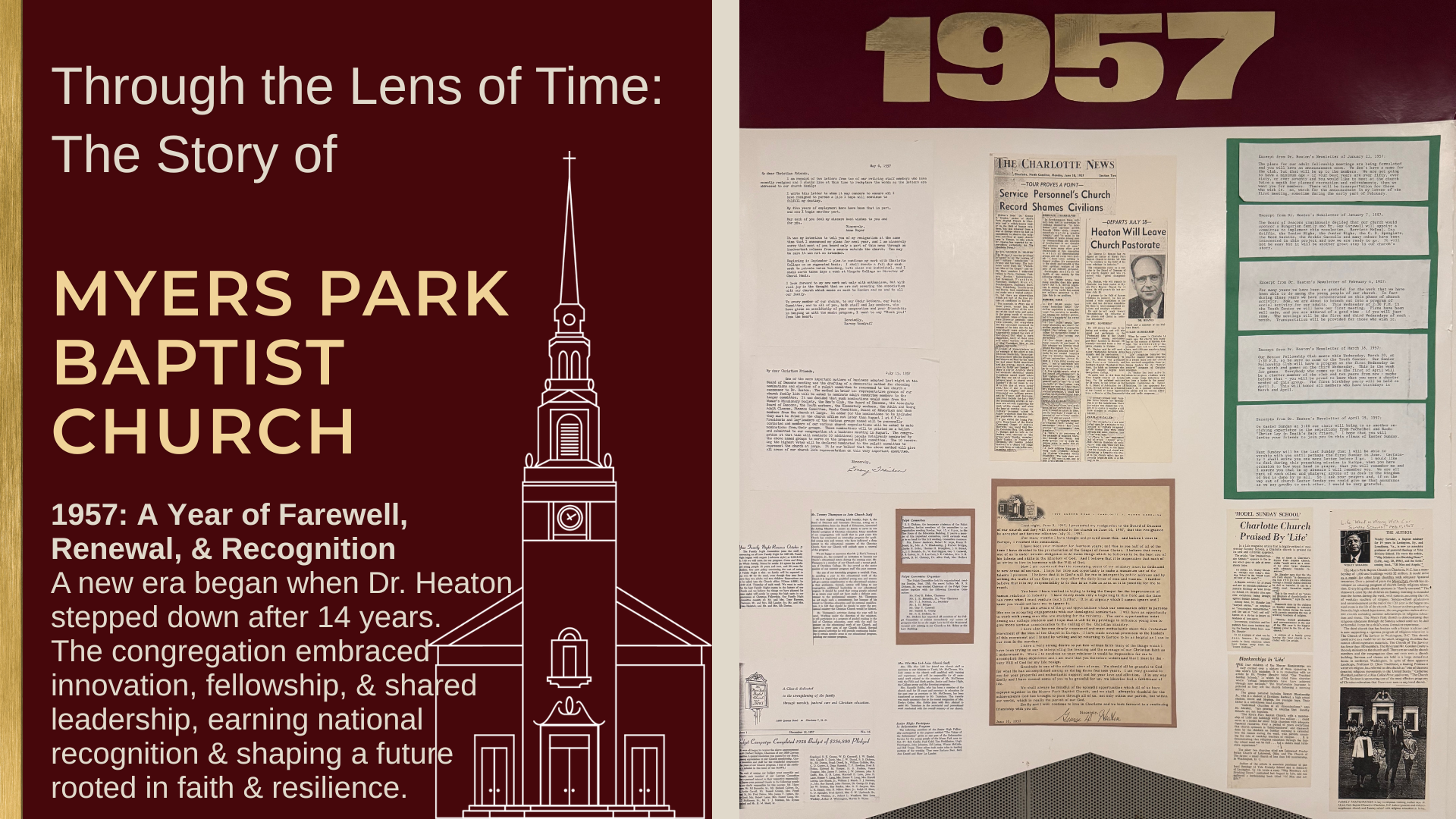
1957: A Year of Farewell, Renewal, and Recognition
The summer of 1957 brought an unexpected turning point for Myers Park Baptist Church. After fourteen years of guiding the congregation through remarkable growth and national recognition, Dr. George D. Heaton stood before the Board of Deacons and announced his resignation. His words carried both gratitude and conviction—a call to serve in new ways, shaping human relations in industry and expanding the reach of Christian influence. For the church, his decision was bittersweet: a farewell to a beloved leader and the beginning of a new chapter. Yet even in transition, the spirit of Myers Park Baptist thrived—welcoming young leaders, deepening community life, and earning praise for its groundbreaking approach to Christian education. 1957 was not merely a year of change; it was a year of courage, vision, and faith in the future.
The Resignation of Dr. George D. Heaton
On June 9, 1957, after fourteen years of ministry, Dr. George D. Heaton presented his resignation to the Board of Deacons. His decision, though prayerfully considered over many months, came as a surprise to the congregation. Dr. Heaton’s resignation was motivated by a strong sense of calling to a new field of ministry, human relations in industry, an area where he had already begun to make a national impact.
In his letter, Dr. Heaton wrote with both gratitude and conviction:
“I believe that every one of us is under solemn obligation to do those things which he believes to be the best use of his talents and skills in the Kingdom of God… I am convinced that the remaining years of my ministry must be dedicated to new areas of service.”
He envisioned a broader ministry through lecturing, writing, and engagement with industry, aiming to “strengthen the influence of the church and Christ in industrial relations.” He also spoke of his continued involvement with the Protestant Men of the Chapel Movement in Europe and his desire to write on the lived meaning of the Christian faith.
Under his leadership, church membership grew from 416 to 1,677, with 2,259 new members added. The congregation had moved from meeting at Queens College to its own thriving campus, known nationally for its innovative, family-centered Christian education program.
While Dr. Heaton’s departure was met with deep regret; he and his wife Emily assured the church that they would remain in Charlotte and continue their friendship with the congregation.
Dr. Heaton’s successor was not immediately chosen; instead, the Board of Deacons designed a democratic process for forming a pulpit committee. Each church organization and constituency was invited to nominate representatives, ensuring that “all areas of church life” would have a voice in the discernment process. This inclusive model reflected the congregation’s maturing sense of shared leadership and community responsibility.
Staff Transitions and Continuing Ministry
Prior to Dr. Heaton’s announcement, Music Director Harvey Woodruff and Choir Director Anna Royer also tendered their resignations. Both expressed heartfelt gratitude for their years of service and their deep affection for the church community. Woodruff, who had led the music ministry with distinction, announced his new role as Director of Choral Music at Wingate College, while continuing limited work with the Charlotte College.
A New Generation of Leadership: The Return of Tommy Thompson
Even amid transition, Myers Park Baptist continued its tradition of nurturing future leaders. In September, the church welcomed J. Earl “Tommy” Thompson, Jr., a Davidson College graduate, and member of the congregation, as Educational Intern. His appointment renewed the church’s internship program, designed both to inspire young adults toward ministry and to strengthen the congregation’s educational life. Thompson’s work included guided reading, seminar participation, and practical leadership in church school and summer programs, a continuation of the congregation’s long-standing commitment to the educational ministry as a calling.
All-New Family Night
Community life was central to Myers Park Baptist Church, and in 1957 the Family Night Committee set out to make the 1957–1958 season the most memorable yet. Their vision was clear: create evenings of fellowship that would become highlights of the church year. Each Thursday began with a cafeteria-style supper at 6:00 pm, followed by engaging programs for all ages at 7:00 pm. To ensure everyone could participate, meal prices were kept affordable—$1 for adults and youth over 12, 50 cents for children, and no family paying more than $3. Leading this effort were Mr. and Mrs. Tony Harmon (Chairman), Mr. and Mrs. Bill Lander, Sr., Mr. and Mrs. Dean Hamrick, and Mr. and Mrs. Sib Dorton, whose dedication helped strengthen bonds of Christian fellowship across the congregation.
Faithful Stewardship and Growth
By December, the church completed its 1958 budget campaign, pledging an impressive $256,800, signaling both financial strength and continued lay commitment during a season of pastoral transition.
National Recognition for Educational Innovation
Perhaps the most remarkable affirmation came from Life magazine, which featured Myers Park Baptist Church in an article titled “Our Troubled Sunday Schools” (December 1957). While the piece criticized outdated models of religious education nationwide, it praised Myers Park Baptist as a “model for other large churches” for its creative, family-centered approach:
“It is demonstrating that religious education through a Sunday School need not be dull or harmful. It can be a child’s most formative experience.”
The article highlighted the church’s integration of home and congregational education, in which parents became weekday teachers and faith formation extended beyond Sunday morning. “Sunday School graduation at the end of the 12th year,” the article noted, “is the biggest annual event in the life of the church.” Accompanying the article was a photograph of the Mercer Blankenship children (Rachel, David, Mercer Jr, and Stephen) walking out of the sanctuary after morning service.
As 1957 drew to a close, Myers Park Baptist Church stood at a crossroads, grieving the departure of a beloved pastor while embracing the promise of renewal. Dr. Heaton’s resignation was more than an ending; it was a testament to his unwavering commitment to serve where he felt most called. In the midst of change, the congregation demonstrated resilience and vision: strengthening its educational ministry, deepening fellowship through Family Night, and earning national recognition for its innovative approach to Christian formation. What could have been a year of uncertainty became a year of courage and creativity, a reminder that faith is not static but ever unfolding, calling God’s people to trust the future with hope.