
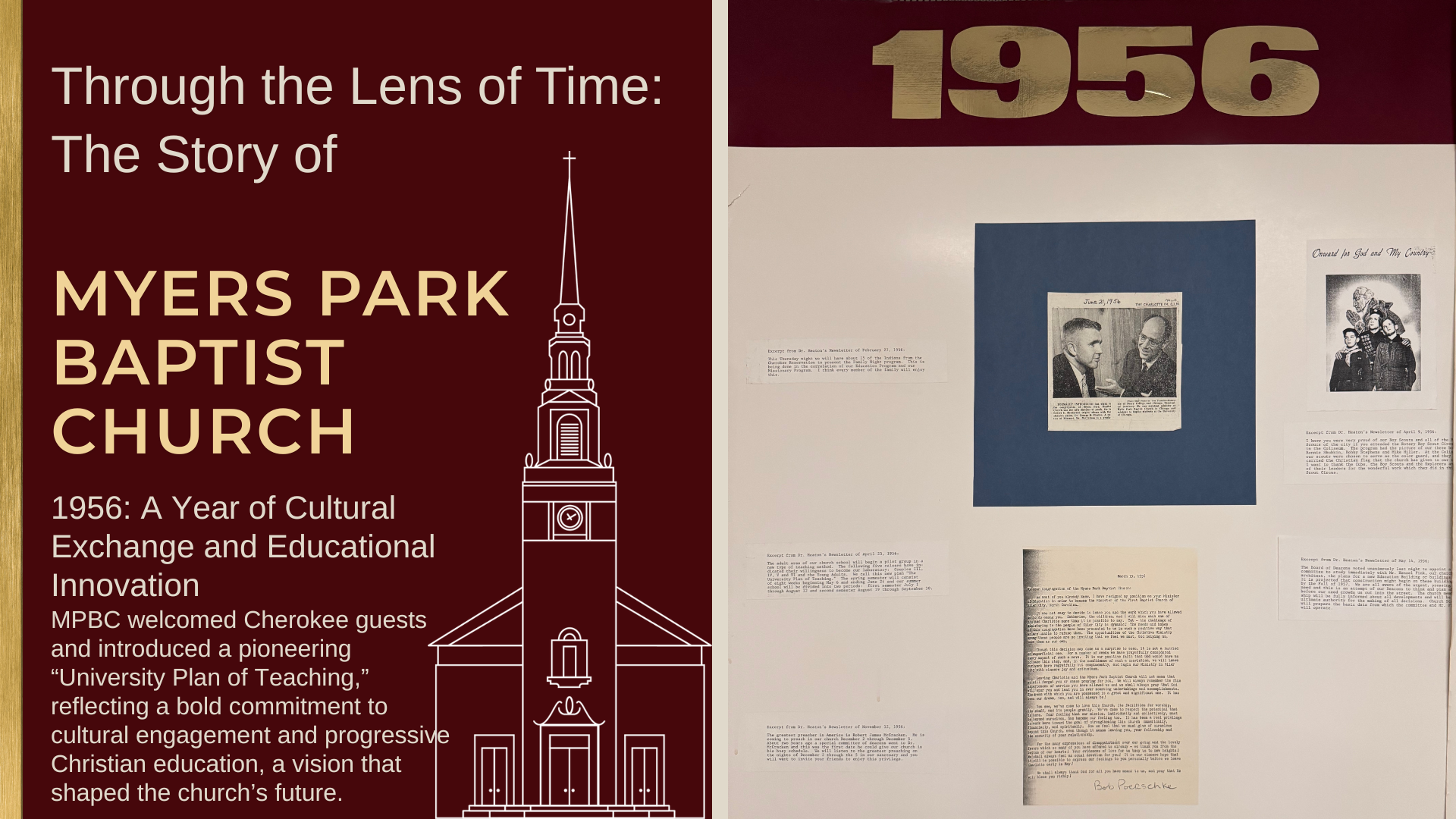
1956: A Year of Cultural Bridges and Bold Educational Experiments
The year 1956 marked a turning point for Myers Park Baptist Church—a season defined by bold ideas and meaningful connections. From welcoming Cherokee guests for a Family Night program to launching a pioneering “University Plan of Teaching” in adult education, the congregation embraced a spirit of openness and progress. These initiatives reflected a growing commitment to cultural engagement and theological learning, signaling a church eager to expand its horizons while deepening its roots in faith and community.
New Leadership and Youth Focus
Early in 1956, Robert E. McClernon was formally introduced as the new Director of Youth. A graduate of Drury College and Chicago Theological Seminary, McClernon brought strong academic and pastoral training from his work in Hyde Park, Chicago, and with Baptist students at the University of Chicago. His appointment signaled the church’s growing commitment to ministry with young people—a continuation of its emphasis on education and formation that had defined the previous years.
Cultural Exchange and Family Engagement
In February, Dr. Heaton invited about 15 guests from the Cherokee Reservation to lead a Family Night program. This collaboration—linking the educational and missionary programs—demonstrated the church’s emerging spirit of cultural engagement and its commitment to learning from diverse communities.
Innovations in Christian Education
By spring, the church launched a new “University Plan of Teaching” within the adult church school. Five classes volunteered to pilot this “laboratory” approach, which framed church education as a kind of continuing theological university. The structure—organized into semesters with specific learning outcomes—reflected a forward-thinking approach to Christian education, mirroring trends in progressive theological pedagogy during the 1950s.
Transitions in Staff Leadership
A significant farewell came from Bob Presschke, Minister of Education, who announced his resignation to become pastor of the First Baptist Church of Siler City, North Carolina. His heartfelt letter to the congregation emphasized shared vision, gratitude, and the conviction that their collective mission must always reach “beyond ourselves.” His words capture the theology of calling and movement that characterized Myers Park Baptist’s ethos under Dr. Heaton’s leadership.
Youth and Scouting Recognition
The church’s Boy Scouts gained citywide recognition at the Rotary Boy Scout Circus in the Charlotte Coliseum, where they were chosen to serve as the color guard and to carry the Christian flag donated by the church. The program included the picture of MPBC scouts Ronnie Shubkin, bobby Stephens, and Mike Miller. This symbolic moment represented the church’s investment in forming young leaders grounded in faith and service.
Vision for Expansion
In May, the Board of Deacons initiated planning for a new Education Building, engaging architect Hensel Fink to draft proposals. The church anticipated beginning construction in fall 1957—a sign of the congregation’s rapid growth and the need for expanded facilities for its thriving education and fellowship ministries. In a newsletter article Dr. Heaton wrote, "We are all aware of the urgent, pressing need and this is an attempt of our Deacons to think and plan before our need crowds us out into the street."
A Spirit of Excellence and Inspiration
Finally, Dr. Heaton’s November newsletter announced an exciting event: Dr. Robert James McCracken, considered one of America’s most accomplished preachers, would lead a series of sermons at the church in December. Hosting such a notable voice underscored Myers Park Baptist’s standing as an intellectual and spiritual center, committed to excellence in preaching and worship.
As 1956 drew to a close, Myers Park Baptist stood at the intersection of tradition and transformation. The year’s initiatives—from cultural engagement with Cherokee neighbors to pioneering approaches in Christian education—revealed a congregation willing to learn, adapt, and lead. These efforts were not isolated experiments but part of a larger vision: to create a church that embraced diversity, nurtured intellectual growth, and prepared for the future with courage and faith. In many ways, 1956 was more than a year of change—it was a blueprint for the decades to come.